Introduction
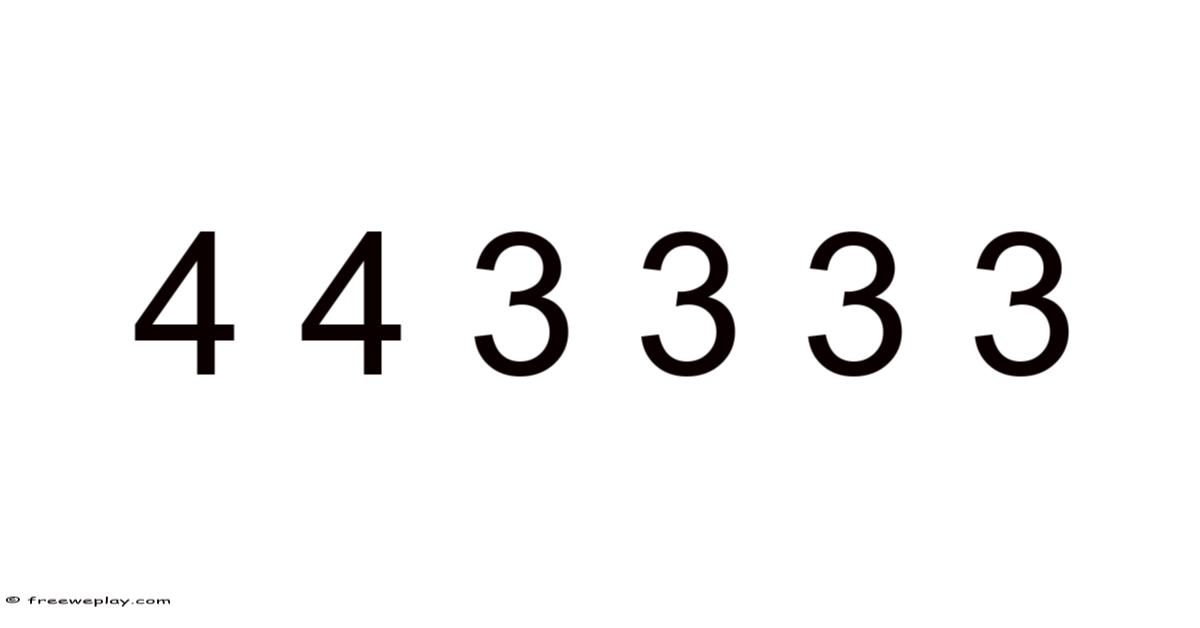
Imagine stepping onto a dance floor where the music shifts every few beats, creating a subtle push‑and‑pull that keeps you engaged. This ebb and flow is exactly what the 4 4 3 3 3 3 pattern delivers. In musical terms, “4 4 3 3 3 3” describes a sequence of two measures in 4/4 time followed by four measures in 3/4 time. The pattern is simple to count but powerful enough to shape the feel of a piece, from folk ballads to modern rock riffs. Understanding this rhythmic skeleton helps musicians, producers, and even listeners appreciate the underlying structure that drives many familiar songs.
Detailed Explanation
The 4 4 3 3 3 3 pattern is essentially a hybrid meter that alternates between two common time signatures: 4/4 (common time) and 3/4 (waltz time). That said, in a 4/4 measure, there are four quarter‑note beats, giving the music a steady, marching feel. When the pattern switches to 3/4, each measure contains three quarter‑note beats, which introduces a gentle sway and a sense of forward motion. By placing two 4/4 measures at the start, the music establishes a familiar foundation before the shift to 3/4 adds contrast and momentum.
Historically, this alternating structure can be traced back to traditional folk dances where a steady pulse (4/4) sets the stage for a lively reel (3/4). In the 20th‑century pop and rock eras, composers such as The Beatles and Led Zeppelin employed similar shifts to create memorable hooks. The 4 4 3 3 3 3 layout therefore serves both as a practical counting tool and as a compositional device that balances stability with surprise.
For beginners, think of the pattern as a “two‑step forward, three‑step back” routine. The repeated 3‑beat measures can be felt as a gentle rocking motion, which is why the pattern feels both grounding and slightly off‑kilter. You count 1‑2‑3‑4 twice, then 1‑2‑3 four times. This duality is what makes 4 4 3 3 3 3 a favorite among songwriters seeking to add a fresh rhythmic flavor without abandoning the listener’s sense of predictability.
Worth pausing on this one.
Step‑by‑Step or Concept Breakdown
- Identify the basic units – Start by recognizing that each “4” represents a 4/4 measure (four beats) and each “3” represents a 3/4 measure (three beats).
- Count the beats – Use a simple counting method:
- For the first two measures: 1‑2‑3‑4, 1‑2‑3‑4.
- For the next four measures: 1‑2‑3, 1‑2‑3, 1‑2‑3, 1‑2‑3.
- Notate the pattern – In sheet music, write the time signatures at the start
The interplay of rhythm here acts like a dynamic dance between stability and fluidity, where the interplay of time signatures creates a subtle yet compelling push-and-pull. On the flip side, by balancing the weight of familiar 4/4 measures with the lighter 3/4 interludes, it crafts a tapestry where predictability and surprise coexist, enhancing emotional resonance. That's why mastery of this rhythm bridges structure and expression, making it a cornerstone in both composition and performance. Its enduring appeal lies in its ability to elevate simplicity into depth, proving that even the smallest patterns can carry profound significance when executed with care. So this pattern, encapsulated in the 4 4 3 3 3 3 framework, subtly shifts momentum through its alternating cadences, inviting engagement without overwhelming. Here's the thing — such nuanced structure finds its voice in music, where it guides progression while allowing space for creativity. Thus, this pattern stands not just as a sequence, but as a catalyst for connection and meaning Still holds up..
of the measures Simple, but easy to overlook..
- Mark the transitions – Place a barline between each measure to clearly delineate the change in feel. This visual cue helps performers switch smoothly between the steady pulse and the lilting 3/4 sections.
- Practice the transition points – Focus on the moment when the time signature shifts. The tempo may stay constant, but the emphasis moves from the first beat of 4/4 to the first beat of 3/4, creating a subtle push-pull effect.
- Apply to composition or performance – Use this pattern as a structural backbone for verses, choruses, or instrumental breaks. The alternating meters can signal emotional highs and lows, guiding the listener through the piece.
In modern production, digital audio workstations allow precise placement of these meter changes, making it easier to experiment with the 4 4 3 3 3 3 framework. That's why artists from diverse genres—from progressive rock to electronic—have leveraged this pattern to inject rhythmic sophistication into their work. To give you an idea, the intro of a song might establish the grounded 4/4 pulse, only to launch into a soaring 3/4 section that feels both unexpected and inevitable Simple, but easy to overlook..
When all is said and done, mastering this rhythmic blueprint isn’t just about counting beats—it’s about understanding how space and tension interact. When the steady march of 4/4 gives way to the flowing 3/4, listeners experience a moment of musical breath, a brief suspension that makes the return to 4/4 feel like coming home. This cyclical ebb and flow mirrors natural rhythms, making the 4 4 3 3 3 3 pattern more than a technical exercise; it’s a bridge between mathematics and emotion, structure and spontaneity.
All in all, the 4 4 3 3 3 3 rhythmic framework offers a compelling blend of predictability and surprise, rooted in tradition yet adaptable to modern creativity. That's why by alternating between the grounded stability of 4/4 and the graceful lilt of 3/4, musicians can craft narratives that guide listeners through moments of tension and release. Think about it: whether applied in composition, performance, or analysis, this pattern remains a testament to the enduring power of rhythm to shape human expression. Its legacy spans centuries, from folk dances to contemporary hits, proving that even the simplest structures can carry profound emotional weight when executed with intention and care No workaround needed..
Bringing the Pattern into the Studio
When you move from the rehearsal room to the digital realm, the 4 4 3 3 3 3 motif can be reinforced through a handful of production tricks that keep the listener’s ear locked onto the shifting pulse.
| Technique | How It Works | Why It Helps |
|---|---|---|
| Layered Percussion | Stack a crisp hi‑hat on the 4/4 beats and a softer shaker on the 3/4 beats. | The timbral contrast makes each metric shift audible even when the tempo stays constant. |
| Dynamic Automation | Slightly raise the volume of the snare on the first beat of each 3/4 bar, then dip it back on the following two beats. | Accentuates the “push” of the new downbeat without changing the overall mix balance. |
| MIDI Groove Quantization | Quantize the 4/4 sections to 1/16 notes, but leave the 3/4 sections slightly “off‑grid” (e.But g. Think about it: , 12 PPQ). Here's the thing — | Introduces a subtle human feel that mirrors the natural sway of the meter change. |
| Side‑chain Swell | Route a side‑chain from a low‑frequency synth to the drum bus, triggered on the first beat of each 3/4 bar. | Creates a breathing, almost “heartbeat” effect that signals the listener that something has shifted. |
By embedding these production cues, the rhythmic architecture becomes a living part of the track, not a mere notation on the page.
Real‑World Examples
- Progressive Pop: A vocalist delivers a verse in 4/4, then the pre‑chorus flips to 3/4, allowing the lyrical phrasing to stretch across a longer melodic line. The return to 4/4 for the chorus feels like a release of built‑up tension.
- Electronic Dance Music: A build‑up uses a repeating 4 4 3 3 3 3 pattern in the percussive loop, while synth arpeggios shift their syncopation to match each metric change, giving the drop a sense of inevitable arrival.
- Jazz Fusion: A head arrangement begins with a tight 4/4 swing feel, then moves into a 3/4 “ballad” section where the bass walks in a different rhythmic subdivision, creating a conversational dialogue between the rhythm section and the horns.
These case studies illustrate that the pattern is not a gimmick; it’s a flexible scaffold that can be dressed in any genre’s clothing.
Pedagogical Tips for the Classroom
- Clap‑and‑Count Drill – Have students clap the downbeats while counting “1‑2‑3‑4, 1‑2‑3, 1‑2‑3, 1‑2‑3, 1‑2‑3, 1‑2‑3.” Repeating this a few times builds internalization.
- Call‑and‑Response Writing – Ask learners to write a four‑measure phrase in 4/4, then respond with a three‑measure phrase in 3/4 that mirrors the melodic contour. The back‑and‑forth reinforces the idea of “conversation” between meters.
- Visualization – Use a grid‑paper worksheet where each column represents a beat; shade the 4/4 columns in one color and the 3/4 columns in another. Visual learners often grasp the alternating structure faster when they can see it laid out.
A Final Thought
Rhythm, at its core, is the language of time. That's why the 4 4 3 3 3 3 sequence is a micro‑storytelling device: a solid opening, a gentle drift, and a return home. Its power lies in the contrast between the square‑cornered certainty of four beats and the triangular, flowing motion of three beats. When a composer or performer respects that contrast—by marking transitions, emphasizing new downbeats, and letting the arrangement breathe—the result is a piece that feels both grounded and expansive.
In practice, the pattern invites you to think beyond a single meter, to let two meters converse, and to let that conversation shape the emotional arc of your music. Whether you’re sketching a folk reel, engineering a synth‑laden club anthem, or teaching rhythm to budding musicians, the 4 4 3 3 3 3 framework offers a compact yet potent toolkit.
Conclusion
The enduring allure of the 4 4 3 3 3 3 rhythmic pattern is no accident. Through careful notation, deliberate rehearsal of transition points, and thoughtful production embellishments, this pattern can become a catalyst for connection—drawing listeners into a rhythmic journey that feels both familiar and freshly surprising. In practice, it unites the mathematical precision of meter with the human impulse for narrative flow. Also, by alternating the stability of 4/4 with the lyrical sway of 3/4, it creates a built‑in tension‑release cycle that resonates across cultures and genres. In the end, mastering this simple yet profound sequence reminds us that the most compelling music often emerges from the interplay of order and surprise, a dance of beats that mirrors the rhythm of life itself Which is the point..
