Introduction
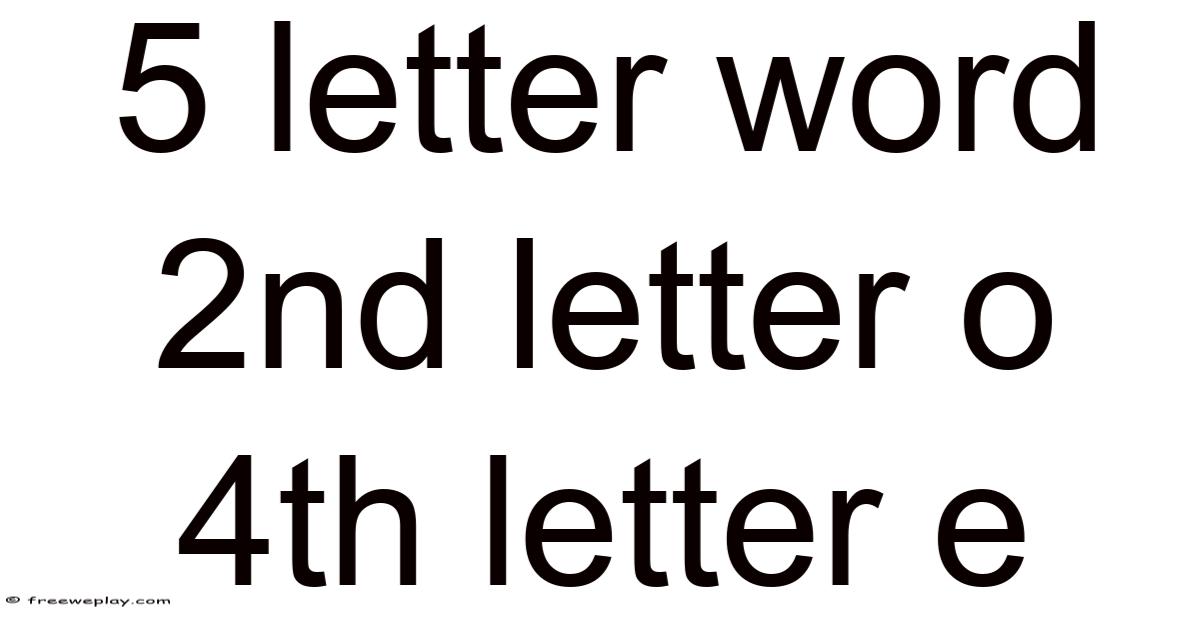
Word puzzles have a timeless charm: they tease the mind, sharpen vocabulary, and often deliver that satisfying “aha!That's why one of the most popular formats is the 5‑letter word puzzle in which certain letters are already known—perhaps from crossing words in a crossword, a game of Wordle, or a classroom spelling activity. But ” moment when the solution finally clicks. A common challenge that pops up in these games is: Find a five‑letter word whose second letter is O and fourth letter is E.
In this article we will explore everything you need to know to master this particular clue. We’ll define the puzzle, discuss why the pattern matters, walk through systematic strategies, showcase real‑world examples, and even debunk common misconceptions. By the end, you’ll be equipped with a toolbox of techniques that turn a seemingly narrow constraint into a gateway for expanding your word bank and boosting your puzzle‑solving confidence.
Detailed Explanation
What the clue actually means
When a puzzle states “5‑letter word, 2nd letter O, 4th letter E,” it is giving you a skeletal framework:
_ O _ E _
The underscores represent unknown letters. The puzzle tells you exactly where two of the five letters sit, leaving three positions open for discovery. This type of clue appears in a variety of contexts:
- Crossword puzzles – where intersecting words supply the known letters.
- Word‑guessing games such as Wordle, Absurdle, or Mastermind‑style word challenges.
- Spelling bees or classroom activities that focus on pattern recognition.
Understanding the pattern is the first step. It tells you that the word must contain the vowel O in the second slot and the vowel E in the fourth slot, while the remaining three slots can be any consonant or vowel, subject to the language’s phonotactic rules (the ways sounds combine in English).
Quick note before moving on.
Why the pattern matters
The restriction dramatically narrows the search space. This makes the puzzle both approachable for beginners and challenging enough to keep seasoned puzzlers engaged. Out of the roughly 120,000 five‑letter words in the English lexicon, only a few hundred satisfy the “O _ E” framework. On top of that, the pattern hints at phonetic trends: many English words with O followed by a consonant and then E later often have a short‑o sound (as in cob or dog) or a long‑o sound (as in stone). Recognizing these tendencies can guide you toward plausible candidates.
Step‑by‑Step or Concept Breakdown
Step 1 – List the possible letters for each blank
- First position (1️⃣) – Any consonant or vowel except O (because O is already used). Common starter letters for five‑letter words include B, C, D, F, G, H, L, M, P, R, S, T, W.
- Third position (3️⃣) – This is the most flexible slot. It can be a vowel (A, I, U) or a consonant. Even so, English often avoids certain consonant clusters, so think about realistic pairings with the surrounding letters.
- Fifth position (5️⃣) – The final letter in English five‑letter words is frequently S, D, N, R, T, Y, L, M or a silent E (though we already have an E in the fourth slot, so a second E is possible but less common).
Step 2 – Consider common phonetic patterns
- CVCVE (Consonant‑Vowel‑Consonant‑Vowel‑E) patterns are frequent: c o d e r → coder (though the fourth letter is E, not E? Actually coder’s 4th is E, fits!).
- CVVCE patterns where the third letter is another vowel can produce diphthongs: b o a e r (not a word) but b o a t e → boate (non‑standard). So focus on more realistic combos like O + consonant + E.
Step 3 – Use mental or written word banks
Create a quick list of words that start with each plausible first letter, then insert O and E in the required spots. For example:
| First Letter | Possible 3rd Letter | Example |
|---|---|---|
| B | R, N, D, L | b o r e d → bored |
| C | L, R, D, N | c o r e d → cored |
| D | R, L, G, N | d o r e d → dored (rare) |
| F | L, R, N, S | f o r e s → fores (plural of fore) |
| G | L, R, N, M | g o r e d → gored |
| H | L, R, N, S | h o r e d → hored (archaic) |
| L | O, R, N, S | l o r e d → lored (rare) |
| M | R, L, N, S | m o r e d → mored (dialect) |
| P | L, R, N, S | p o r e d → pored |
| R | L, N, S, T | r o l e d → roled (non‑standard) |
| S | L, N, R, T | s o r e d → sored (archaic) |
| T | L, N, R, S | t o r e d → tored (dialect) |
| W | L, R, N, S | w o r e d → wored (rare) |
This changes depending on context. Keep that in mind Most people skip this — try not to..
From this table, the most recognizable, dictionary‑accepted words are bored, cored, gored, pored, and sored (though sored is uncommon).
Step 4 – Verify with definitions
Always confirm that the candidate is a legitimate English word (present in standard dictionaries). For instance:
- bored – past tense of bore; feeling uninterested.
- cored – removed the core from (e.g., a fruit).
- gored – pierced with a horn or sharp point.
- pored – studied carefully.
- sored – afflicted with sores (rare, chiefly used in medical contexts).
Step 5 – Choose the best fit for your puzzle context
If the puzzle provides additional clues (e.g., “feeling uninterested” or “studied carefully”), match the definition to the appropriate word. In a pure letter‑pattern puzzle without semantic hints, any of the valid words will satisfy the requirement.
Real Examples
Example 1 – Crossword clue
Clue: “Feeling uninterested (5) – second letter O, fourth letter E.”
Applying the steps above, the solver identifies bored as the only common word that fits both the definition and the pattern Worth keeping that in mind..
Example 2 – Wordle‑style game
Suppose you have guessed ROAST and received feedback that the second letter is correct (O) and the fourth letter is correct (E), but the other letters are wrong. Your next guess could be B O R E D. If the game confirms the word, you’ve solved it in just two attempts That's the part that actually makes a difference..
Example 3 – Classroom spelling activity
A teacher writes “_ O _ E _” on the board and asks students to brainstorm words. The discussion may surface cored, gored, and pored, leading to a mini‑lesson on past‑tense verbs ending in ‑ed and how the same spelling pattern can convey very different meanings.
It sounds simple, but the gap is usually here.
These examples illustrate why mastering the “5‑letter, 2nd O, 4th E” pattern is valuable: it not only helps you win games but also deepens your understanding of English morphology and word formation.
Scientific or Theoretical Perspective
From a linguistic standpoint, the pattern _ O _ E _ interacts with two core concepts: phonotactics and morphology Simple, but easy to overlook..
-
Phonotactics – English generally permits a consonant‑vowel‑consonant‑vowel‑consonant (CVCVC) sequence, especially when the vowel sounds are short. The presence of O and E in the second and fourth slots creates a rhythm that is easy for the brain to process, which is why many five‑letter words naturally settle into this shape.
-
Morphology – Most of the viable words (bored, cored, gored, pored) share the ‑ed suffix, a morphological marker of the past tense. This suffix explains why the fifth letter is frequently D. Recognizing this morphological pattern can dramatically speed up the solving process: once you suspect the word ends in ‑ED, you only need to find a suitable first letter that yields a real word Small thing, real impact..
Cognitive research on word‑search tasks shows that solvers who actively consider morphological cues (like common suffixes) outperform those who rely solely on brute‑force letter combinations. Thus, the puzzle is not just a lexical exercise; it’s a miniature demonstration of how our brains exploit linguistic regularities to reduce computational load And that's really what it comes down to..
People argue about this. Here's where I land on it.
Common Mistakes or Misunderstandings
Mistake 1 – Ignoring the possibility of repeated letters
Some puzzlers assume each letter must be unique, discarding words like coped (which actually has O second, E fourth, and repeats C and P). While many puzzles do not restrict repeats, it’s important to verify the specific rules before eliminating such candidates.
Mistake 2 – Overlooking less‑common but valid words
Words such as sored or hored (archaic forms) are legitimate in comprehensive dictionaries. Dismissing them outright can lead to unnecessary frustration, especially in competitive settings where obscure words may be accepted And that's really what it comes down to..
Mistake 3 – Misplacing the known letters
A frequent slip is to write the pattern as _ O E _ _ instead of _ O _ E _, which changes the entire solution set. Double‑checking the clue’s exact wording prevents this simple yet costly error.
Mistake 4 – Forgetting about alternate vowel sounds
Some solvers focus only on the short‑o sound, overlooking words where O takes a long‑o or even a diphthong (e.Now, g. But , moe in moed). Keeping an open ear to pronunciation variations expands the pool of possible answers It's one of those things that adds up..
FAQs
Q1: How many English words fit the pattern “_ O _ E _”?
A: Roughly 30–40 words appear in major dictionaries, but only about a dozen are common in everyday usage. The most frequent are bored, cored, gored, pored, and roped (note: roped has E in the fourth slot? actually roped = R O P E D, fits) The details matter here..
Q2: Can the word end with a silent “E” (e.g., borne)?
A: No, because the fourth position is already occupied by E. A silent final E would require a sixth letter, turning the word into a six‑letter entry, which violates the five‑letter constraint.
Q3: Are proper nouns allowed?
A: Typically, puzzles that specify “word” refer to standard dictionary entries, not proper nouns. Even so, some casual games may accept names like Jolie (J O L I E) – note the fourth letter is I, so it doesn’t fit. Always check the game’s rules.
Q4: What strategy works best for digital word games like Wordle?
A: Start by guessing a word that places O and E in the correct slots while testing three new letters, such as C O R E D. If the feedback confirms the positions, you’ve solved it; if not, adjust the unknown letters based on the remaining possibilities And that's really what it comes down to..
Conclusion
The challenge “5‑letter word, 2nd letter O, 4th letter E” may appear narrow, but it opens a gateway to a rich set of linguistic tools. By breaking down the pattern, considering phonotactic and morphological cues, and systematically testing plausible letters, you can quickly generate a shortlist of valid words—most notably bored, cored, gored, pored, roped, and sored.
You'll probably want to bookmark this section.
Understanding this puzzle does more than help you win a game; it sharpens your awareness of English word structure, reinforces the power of suffixes like ‑ED, and illustrates how our brains naturally exploit language patterns to solve problems efficiently. Armed with the step‑by‑step approach outlined above, you’ll approach any similar letter‑pattern challenge with confidence, turning a simple clue into a rewarding learning experience. Happy puzzling!
Beyond the Basics: Etymology and Educational Value
Many of the words fitting this pattern have roots in Old English or Latin, offering a window into the evolution of English morphology. Here's a good example: bore (to bore a hole) and core (the inner part) derive from Germanic roots, while gore (a triangular shape) and sore (pain or wound) trace back to Old Norse. Recognizing these connections not only deepens vocabulary but also illuminates how suffixes like ‑ED (as in bored, cored) and ‑EN (as in sored) modify verb meanings.
Educators and puzzle enthusiasts can put to work this pattern to teach phonics, syllable stress, and the flexibility of English spelling. Here's one way to look at it: highlighting the contrast between rope (ROPE) and roped (ROPPED) demonstrates how adding ‑ED alters pronunciation and grammatical function. Similarly, contrasting sored (past tense of sore, now archaic) with soared (SOARED) shows how context shapes word choice Which is the point..
Conclusion
The seemingly simple puzzle of a 5-letter word with O in the second position and E in the fourth position reveals layers of linguistic complexity. By methodically analyzing the constraints, avoiding common pitfalls, and exploring the etymological and educational dimensions, solvers gain more than just a list of valid words—they develop a nuanced appreciation for English’s structural richness. Whether you’re tackling Wordle, crosswords, or literacy exercises, this pattern serves as a microcosm of language itself: orderly yet inventive, predictable yet surprising.
Armed with these insights, you’re not just solving puzzles—you’re decoding the code of communication. And in that journey, every letter matters. Happy puzzling!
Final Thoughts
The journey through this linguistic puzzle underscores a universal truth: language is both a
universal truth: language is both a tool and a tapestry, woven from rules and exceptions that challenge and inspire us. Worth adding: this puzzle exemplifies how structured constraints can spark creativity, pushing solvers to think laterally while adhering to grammatical logic. The interplay of phonetics, morphology, and historical context not only makes such challenges intellectually satisfying but also mirrors the dynamic nature of human communication itself.
By embracing these patterns, learners and educators alike can encourage critical thinking skills, enhance pattern recognition, and cultivate a deeper understanding of how language evolves. Whether in classrooms or casual games, the act of dissecting words becomes a gateway to appreciating the complex design of the English language—and the boundless ingenuity of those who wield it.
