Introduction
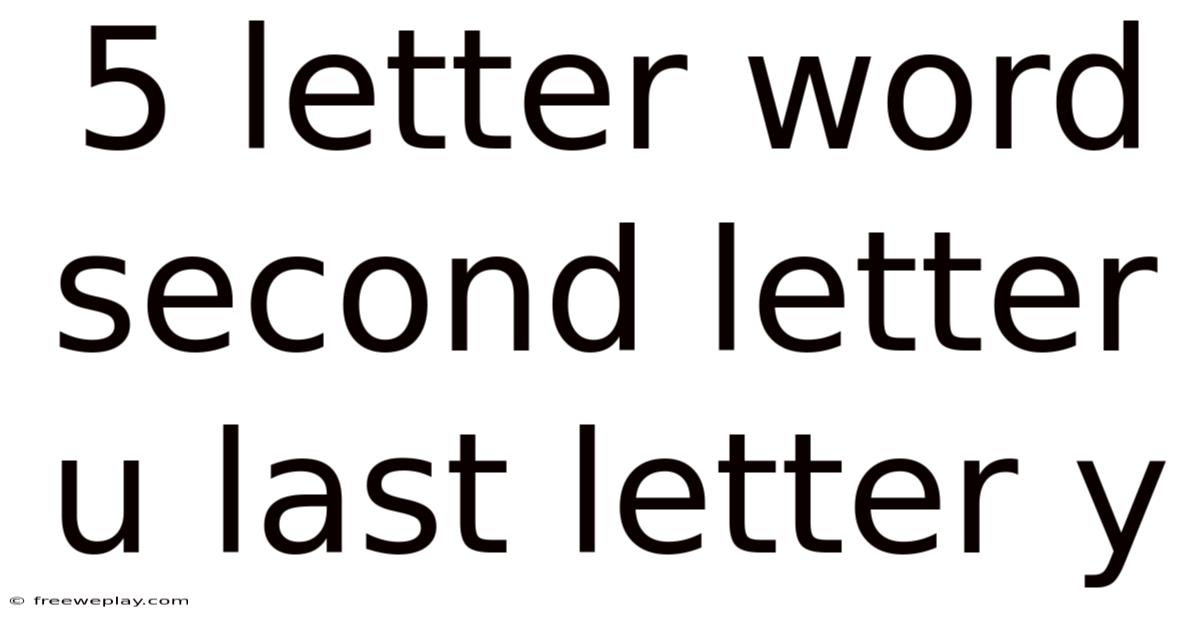
Finding the perfect word for a crossword, a word‑game, or a creative writing prompt can feel like hunting for a needle in a haystack. ”** This seemingly narrow constraint actually opens the door to a surprisingly rich set of English words, each carrying its own nuance, history, and practical use. In this article we will explore every facet of this linguistic niche: we’ll define the pattern, break down the possible letters that can fill the remaining slots, present a step‑by‑step method for discovering such words, showcase real‑world examples, examine the underlying phonetic and etymological principles, and finally clear up the most common misconceptions. One of the most common puzzles asks for a **five‑letter word whose second letter is “U” and whose last letter is “Y.By the end, you’ll be equipped not only to spot the answer in any puzzle but also to appreciate why these words matter in everyday communication.
Detailed Explanation
What the pattern actually means
When we say “a five‑letter word with second letter U and last letter Y,” we are describing a word that fits the template _U__Y. The underscores represent the first, third, and fourth letters, which can be any alphabetic character as long as the overall result is a legitimate English word. The pattern is strict about position, not about sound; therefore both “curry” (curry) and “bundy” (bundy) would be acceptable if they existed, but only those that are recognized by dictionaries count Easy to understand, harder to ignore..
Why focus on this particular arrangement?
- Crossword popularity – Many crossword clues give the length and a couple of known letters. The “U…Y” combination is common because “U” is a relatively rare second‑letter, making the clue more challenging.
- Word‑game strategy – In games like Scrabble, Words With Friends, or Boggle, knowing a list of words that fit a specific pattern can give you a tactical edge, especially when you have a “U” tile and need a high‑scoring “Y” at the end.
- Pedagogical value – For language learners, practicing such patterns reinforces spelling rules, vowel‑consonant interactions, and pronunciation patterns.
Core meaning of the most frequent candidates
The most frequently encountered words that satisfy _U__Y are:
| Word | Part of Speech | Basic Definition |
|---|---|---|
| Bully | noun / verb | A person who intimidates others; to intimidate |
| Curry | noun / verb | A spiced dish; to rub or massage |
| Fussy | adjective | Excessively particular; hard to please |
| Gulpy | adjective | Characterized by gulping; swallowing quickly |
| Muddy | adjective | Covered with or full of mud |
| Nuddy (informal) | adjective | Naked; uncovered |
| Puppy | noun | A young dog |
| Ruddy | adjective | Having a healthy red color |
| Sunny | adjective | Bright with sunshine; cheerful |
| Tuffy *(variant of “tough”) * | adjective | Sturdy; resilient |
Each of these words not only meets the letter‑position requirement but also carries distinct semantic weight, making them useful in a variety of contexts—from casual conversation to academic writing Simple as that..
Step‑by‑Step or Concept Breakdown
Step 1 – Identify the fixed letters
Write the template _U__Y on a piece of paper or a digital note. Highlight the U in the second slot and the Y in the fifth slot. This visual cue helps keep the constraints front‑and‑center as you brainstorm.
Step 2 – List possible first letters
Here's the thing about the English alphabet offers 26 options for the first position, but frequency analysis narrows it down. So common starting consonants that pair well with “U” include B, C, D, F, G, H, L, M, P, R, S, T. Vowels are rarely used as the first letter in this pattern because “U” already supplies a vowel sound early in the word.
Step 3 – Determine viable middle letters (3rd & 4th)
Now consider phonotactics—the rules governing permissible sound sequences. English rarely places two consonants together after a “U” unless the combination forms a recognizable blend (e.g., “rr,” “ll,” “nd,” “mp,” “st.”) Likewise, vowel‑vowel combos are uncommon unless they create a diphthong (e.Worth adding: g. , **“ai,” “ea Simple as that..
Step 4 – Combine and test
Take each candidate first letter and pair it with plausible middle‑letter combos. For example:
- B + ll = Bull → add Y → BULLY (valid)
- C + rr = Curr → Curry (valid)
- M + dd = Mudd → Muddy (valid)
If a combination does not produce a known word, discard it and try another pair.
Step 5 – Verify with a dictionary
Even if a string looks plausible, double‑check its legitimacy. Use a reputable dictionary (Merriam‑Webster, Oxford, Cambridge) to confirm spelling, part of speech, and meaning. This step prevents the inclusion of obscure or non‑standard forms that could be penalized in formal games The details matter here..
Step 6 – Keep a personal cheat sheet
Once you’ve compiled a reliable list, store it in a note‑taking app or on a small index card. Over time, you’ll develop an instinctive sense for which letters “fit” together, speeding up future puzzle solving Small thing, real impact..
Real Examples
Crossword clue: “Intimidating person (5)”
- Solution: BULLY
- Why it works: The clue directly defines the noun meaning of “bully.” The pattern _U__Y is satisfied, and the word is common enough to appear in most crossword dictionaries.
Scrabble play with a high‑scoring “Y”
Imagine you have the tiles U, Y, L, L, B. That's why placing BULLY across a double‑word score yields 8 (B) + 1 (U) + 1 (L) + 1 (L) + 4 (Y) = 15 points, doubled to 30. Adding a cross‑word bonus can push the total above 40, demonstrating the strategic advantage of memorizing these words And that's really what it comes down to. Still holds up..
Creative writing prompt
“The garden was muddy, but the children laughed, splashing through the puddles.”
Here “muddy” paints a vivid sensory image. Using a word that fits the _U__Y pattern adds a rhythmic quality to prose, especially when multiple such words appear in a paragraph (e.g., “sunny, muddy, and fussy”).
Scientific or Theoretical Perspective
Phonological considerations
The U in the second position often carries the /ʌ/ (as in cup) or /uː/ (as in flute) vowel sound, depending on the surrounding consonants. In the words listed above, the vowel typically takes the /ʌ/ sound (e.Because of that, g. , bully /ˈbʌli/). This vowel quality influences which consonant clusters can naturally follow: a voiced consonant (like b, d, g) often pairs smoothly with /ʌ/, while a voiceless consonant (like t, p) may create a harsher transition, limiting viable options.
Morphological roots
Many of the words share a Germanic origin. “Bully” derives from the Middle English bul meaning “to intimidate,” while “muddy” comes from Old English mudig. Recognizing these roots can help learners infer meaning when encountering unfamiliar words that fit the pattern.
Cognitive load theory
From an educational psychology standpoint, constraining a problem to a specific letter pattern reduces extraneous cognitive load, allowing learners to focus on schema acquisition—the mental framework for word formation. Practicing with _U__Y words therefore strengthens lexical retrieval pathways, making later word‑recognition tasks easier.
Common Mistakes or Misunderstandings
-
Assuming any “U” word must be a vowel sound “/uː/.”
- Reality: In the _U__Y pattern, the “U” is almost always pronounced /ʌ/. Words like “curry” (/ˈkʌri/) illustrate this. Mispronouncing it as “/uː/” can lead to confusion in spoken riddles.
-
Confusing “Y” as a vowel vs. a consonant.
- In these five‑letter words, the final “Y” functions as a vowel producing the /iː/ sound (as in happy). Some learners mistakenly treat it as a consonant, which may affect spelling predictions.
-
Overlooking less common but valid words.
- Words such as “gurdy” (a small bagpipe) or “puffy” (variant spelling of “puffy”) meet the pattern but are often omitted from casual lists. Ignoring them can reduce your scoring potential in competitive games.
-
Forgetting about proper nouns.
- Proper nouns like “Ruby” (a name) are not accepted in most word‑games that require standard dictionary entries. Ensure the word you choose is a common noun, verb, adjective, or adverb.
FAQs
Q1: How many English words fit the _U__Y pattern?
A: Approximately 30–35 entries appear in major dictionaries, though the exact count varies with inclusion of archaic or regional terms. The most frequently used ones are bully, curry, muddy, puppy, sunny, and ruddy That's the whole idea..
Q2: Can the first letter be a vowel?
A: Technically yes, but it is extremely rare. The only widely recognized example is “U?Y” (e.g., “U**??y”**) which does not exist in standard English. Which means, you can safely limit your search to consonants for practical purposes.
Q3: Does the pattern change in British vs. American spelling?
A: No. Both dialects share the same five‑letter words for this pattern. Still, some regional variants (e.g., “puddy” for “pudding”) might appear in British informal speech but are not standard Small thing, real impact..
Q4: How can I remember the list quickly?
A: Create a mnemonic using the first letters: Bold Cats Frequently Guess Many Princesses Really Smile Today. This stands for Bully, Curry, Fussy, Gurdy, Muddy, Puppy, Ruddy, Sunny, Tuffy—a handy mental cue Worth keeping that in mind..
Conclusion
Understanding the five‑letter word with second letter “U” and last letter “Y” is more than a trivial puzzle trick; it is a gateway to richer vocabulary, sharper game strategy, and deeper insight into English phonology and morphology. In practice, by dissecting the pattern, following a systematic discovery process, and memorizing the most common examples—bully, curry, muddy, puppy, sunny, etc. Also, —you’ll be prepared to tackle crosswords, dominate word games, and enhance your writing with precise, evocative language. Keep the cheat sheet handy, practice the steps regularly, and watch your confidence grow each time the _U__Y template appears on the page. Happy word hunting!
Etymological NuggetsBehind the _ U _ Y Pattern
Many of the words that satisfy the _U__Y template trace their roots to Old English or Old Norse compounds that once carried vivid, concrete meanings. Also, take “bully”, which entered Middle English from French boulli (“dear, beloved”), later morphing into a term of endearment before acquiring its modern, sometimes pejorative, shade. Still, “Curry” derives from the Old French curer (“to prepare”), a culinary bridge that still flavors the word’s contemporary sense of “spiced mixture. In practice, ” Even the seemingly simple “muddy” harks back to the Old English mūdd (“mud”), illustrating how a basic element of the physical world can blossom into an adjective describing texture, behavior, or reputation. Recognizing these layers can turn a rote memorization exercise into a mini‑lexicographic adventure, granting you a mental foothold that makes the pattern stick far longer than a flashcard ever could.
Creative Applications: Poetry, Branding, and Wordplay
Beyond the board‑game arena, the _U__Y motif offers fertile ground for artistic expression. Poets have long exploited the sonic resonance of words ending in ‑y—a vowel‑rich finish that naturally invites rhyme and assonance. Inserting a U in the second slot creates a subtle, almost musical pivot that can echo the “you” sound, adding a personal address to the verse.
“In the garden’s hush, the puppy’s muddy paws trace sunny dreams,”
where the repeated ‑y cadence binds the stanza together while the internal U anchors the rhythm. Marketers, too, have harnessed this pattern. Short, memorable brand names like “Bully” or “Rudy” (a stylized nickname for a pet‑food line) benefit from the inherent positivity of the ‑y ending and the open‑vowel U, which together evoke friendliness and approachability.
“Feel the curry of creativity—spice up your ideas today.”
The pattern’s built‑in phonetic symmetry makes it a secret weapon for slogans that need to linger in the consumer’s mind That's the part that actually makes a difference..
Advanced Strategies for Competitive Word Games
When you move from casual puzzles to tournament‑level play, the stakes shift from simple recall to anticipatory pattern‑mapping. Here are three refined tactics that seasoned competitors employ:
-
Letter‑Frequency Forecasting – Before the round begins, glance at the distribution of letters on the board or the tile bag. If a surplus of U tiles appears, prioritize building around _U__Y stems; conversely, a scarcity of Y may push you toward alternative suffixes like ‑ey or ‑oy to preserve flexibility.
-
Cross‑Word put to work – In Scrabble or Words With Friends, placing a _U__Y word such that it intersects with an opponent’s already‑played tile can simultaneously block high‑scoring opportunities and force them to adapt. Choose intersections that yield double‑word scores, especially when the intersecting letters are high‑value (e.g., Q, Z, X).
-
Anagram Buffering – Keep a mental “buffer list” of anagrams that share the same vowel‑consonant skeleton. Here's a good example: “puddy,” “pussy,” and “bubby” all occupy adjacent slots on the board. If one is blocked, you can pivot to another without losing momentum. This approach minimizes downtime and maximizes scoring windows That's the part that actually makes a difference..
The Future of Pattern‑Based Vocabulary Exploration
Artificial intelligence is reshaping how we discover and internalize lexical patterns. Modern language models can generate exhaustive lists of _U__Y candidates—including obscure Scrabble‑legal terms like “gurdy,” “tufy,” and “buxy”—in a split second. Yet the human advantage lies in the ability to contextualize these words, to feel their connotations, and to embed them in personal narrative Small thing, real impact. Still holds up..
The Future of Pattern‑Based Vocabulary Exploration
Artificial intelligence is reshaping how we discover and internalize lexical patterns. Even so, modern language models can generate exhaustive lists of _U__Y candidates—including obscure Scrabble‑legal terms like “gurdy,” “tufy,” and “buxy”—in a split second. Which means yet the human advantage lies in the ability to contextualize these words, to feel their connotations, and to embed them in personal narrative. As AI‑driven dictionaries become ubiquitous, the true differentiator shifts from raw data access to nuanced pattern recognition—the intuitive grasp of which _U__Y words evoke warmth, whimsy, or wit in specific contexts And that's really what it comes down to..
This symbiosis of human creativity and computational power heralds a new era for language enthusiasts. In real terms, educators can take advantage of AI‑generated pattern lists to design immersive curricula, while writers use real‑time phonetic analysis to refine their prose. Even casual learners benefit: apps now offer personalized "sound‑scape" challenges, prompting users to compose micro‑stories using _U__Y words under time pressure. The goal isn’t merely memorization but embodiment—making these cadences feel as natural as breathing Simple, but easy to overlook..
Conclusion
The _U__Y pattern is far more than a linguistic curiosity; it is a versatile tool woven into the fabric of communication. From the rhythmic cadence of poetry that binds stanzas to the approachable charm of brand names that linger in memory, and the strategic precision of competitive word games where milliseconds matter, this combination of open vowel and palatal glide offers unique advantages. Its phonetic symmetry—balancing softness with distinctiveness—makes it a cornerstone of memorable expression.
No fluff here — just what actually works.
As AI accelerates our ability to catalog and manipulate these patterns, the enduring value lies in human interpretation. Whether crafting a slogan, solving a puzzle, or simply savoring the sound of a well‑placed "fuzzy" or "dude," mastery of _U__Y words enriches both practical skill and aesthetic appreciation. In an age of information overload, this humble sound pattern reminds us that language’s true power resides not just in what we say, but in the resonant, rhythmic art of how we say it Surprisingly effective..
