##Introduction
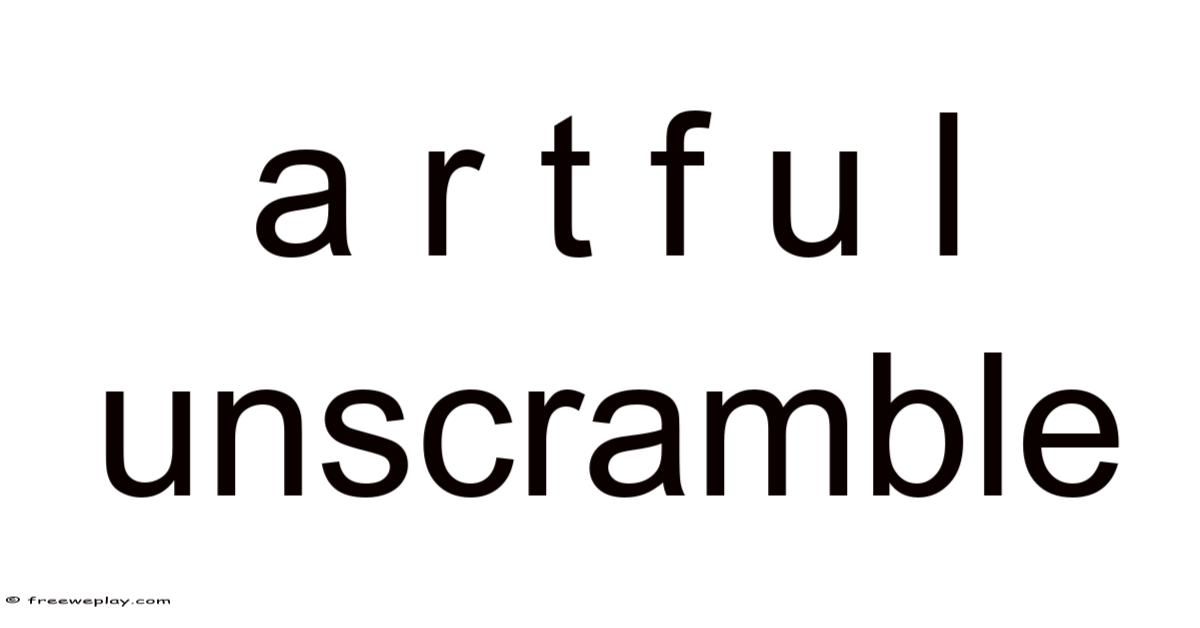
Imagine staring at a jumble of letters—a r t f u l—and feeling the thrill of a puzzle waiting to be solved. On top of that, in this article we will unscramble “artful”, explore the linguistic mechanics behind it, examine real‑world uses, and address common misconceptions. That exact sequence is the scrambled form of the English adjective ARTFUL, a word that carries connotations of cleverness, cunning, and artistic skill. By the end, you’ll not only know how to rearrange those six letters with confidence, but you’ll also appreciate why mastering such unscrambling boosts vocabulary, creativity, and problem‑solving skills.
Detailed Explanation
The scrambled string a r t f u l appears deceptively simple, yet it hides a single, meaningful English word. To decode it, we must understand two fundamental ideas:
-
Letter frequency and position – Each letter in the English alphabet can appear multiple times in a word, but the total count must match the original scrambled set. In “artful,” every letter appears exactly once, so the solution must also be a six‑letter word containing one a, one r, one t, one f, one u, and one l.
-
Morphological patterns – English words often follow recognizable prefixes, suffixes, or root structures. “ART” is a clear root meaning “skill” or “creative expression.” Adding the letters F, U, and L at the end creates the suffix ‑ful, which turns nouns into adjectives meaning “full of” or “characterized by.” Thus, ART + FUL = ARTFUL, literally “full of art” or “artistic.” Understanding these patterns makes the unscrambling process less about random guessing and more about systematic reconstruction. When you recognize that the letters can be grouped as ART + FUL, the solution emerges naturally That's the whole idea..
Step‑by‑Step or Concept Breakdown
Below is a clear, step‑by‑step method you can apply to any six‑letter scramble like a r t f u l:
- List all letters – Write them out: A, R, T, F, U, L.
- Identify common prefixes or roots – Scan for familiar chunks such as ART, FUN, FUR, etc. In our case, ART stands out.
- Check remaining letters – After extracting ART, the leftover letters are F, U, L.
- Form possible suffixes – The combination FUL is a known adjective‑forming suffix.
- Combine – Place the suffix after the root: ART + FUL = ARTFUL.
- Validate – Verify that the resulting word uses exactly the original letters with no additions or omissions. Key takeaways:
- Grouping letters into recognizable chunks speeds up the process.
- Suffix awareness (especially ‑ful, ‑less, ‑ness) is a powerful shortcut. - Cross‑checking ensures the solution respects the original letter count.
Real Examples To see how “artful” functions in context, consider these scenarios:
- Literary description: “The novelist’s artful prose captivated readers, weaving vivid imagery with subtle humor.”
- Creative praise: “She delivered an artful performance, blending dance and storytelling naturally.”
- Critical appraisal: “His artful manipulation of language revealed a deep understanding of rhetorical devices.”
Each example demonstrates why unscrambling the word matters: recognizing ARTFUL allows you to appreciate nuance in writing and speech, enriching both analysis and appreciation of artistic expression.
Scientific or Theoretical Perspective
From a linguistic standpoint, unscrambling words engages cognitive processes tied to pattern recognition, memory retrieval, and lexical access. Research in psycholinguistics shows that the brain treats scrambled strings as non‑words until a coherent lexical representation is formed. This involves:
- Phonological buffering: The brain temporarily holds sound patterns while searching for a matching entry in the mental lexicon.
- Morphological decomposition: Recognizing affixes (like ‑ful) activates morphological rules that map to known word families.
- Semantic verification: Once a candidate word is generated, its meaning is checked against contextual expectations.
These mechanisms highlight why solving puzzles such as artful unscramble not only entertains but also strengthens neural pathways associated with language comprehension and problem‑solving.
Common Mistakes or Misunderstandings
Even seasoned word gamers can stumble over simple scrambles. Here are frequent pitfalls and how to avoid them:
- Mistake 1: Ignoring letter multiplicity – Some assume a letter can be reused. In “artful,” each letter appears only once, so the solution must also contain exactly one of each.
- Mistake 2: Over‑relying on random guessing – Without a systematic approach, you may land on nonsensical strings like “fluart.” Using the root‑suffix strategy prevents wasted effort.
- Mistake 3: Misidentifying suffixes – Not all letter groups form valid suffixes. As an example, “FUTL” does not correspond to any English ending, whereas “FUL” does. Familiarize yourself with common suffixes to filter possibilities quickly.
- Mistake 4: Forgetting proper capitalization – In puzzles, case does not matter, but when writing the unscrambled word, standard capitalization rules apply (i.e., Artful at the start of a sentence).
By recognizing these errors, you can approach each scramble with a clearer mind and higher success rate.
FAQs
1. What other six‑letter words can be formed from the letters “a r t f u l”?
The only standard English word that uses all six letters exactly once is ARTFUL. Any other arrangement either repeats a letter or results in a non‑word It's one of those things that adds up. Took long enough..
2. How can I improve my skill at unscrambling words?
Practice by: - Building a list of common prefixes and suffixes Turns out it matters..
- Playing word‑games like Scrabble or Wordle that reinforce letter patterns.
- Using systematic scanning techniques (e.g., start with the longest root you can spot).
3. Does “artful” have any synonyms that are also six letters long?
Yes. Synonyms of similar length include cunning (7 letters)
Finishingthe answer to the third FAQ, the six‑letter synonyms that convey the same nuance as artful include clever, deftly, adroit, and crafty. Each of these words carries the implication of skillful manipulation or subtle ingenuity, making them useful alternatives when you need a different lexical flavor.
Extending the Practice
Beyond the basic steps of scanning for roots and affixes, you can deepen your unscrambling expertise by incorporating a few additional habits:
-
Chunk the letters – Instead of treating the whole set as a single pool, mentally group them into pairs or triads that often appear together (e.g., “art,” “ful”). This reduces the search space and speeds up recognition Easy to understand, harder to ignore..
-
make use of morphological families – Familiarize yourself with common derivational patterns such as ‑ness, ‑ment, ‑able, and ‑ive. When a scrambled string contains a recognizable suffix, the root often emerges more readily.
-
Use contextual cues – If the puzzle supplies a hint or a theme (for instance, “kitchen tools”), filter your candidate words through that lens. Contextual relevance narrows possibilities dramatically.
-
Employ spaced repetition – Regularly revisit lists of prefixes, suffixes, and high‑frequency letter combinations. The spaced‑rep technique reinforces neural pathways, making future scrambles feel more automatic.
-
Play diverse word games – Engaging with anagrams, cryptic crosswords, and even letter‑based puzzles like Boggle exposes you to a broader spectrum of letter arrangements, sharpening flexible thinking.
The Cognitive Pay‑off
Research consistently shows that the mental operations required to unscramble words activate a distributed network that includes the left inferior frontal gyrus (lexical retrieval), the posterior superior temporal gyrus (phonological buffering), and the anterior cingulate cortex (error monitoring). Repeated practice not only strengthens these regions but also enhances overall problem‑solving agility, a benefit that extends well beyond the realm of word games.
Conclusion
Scrambled strings may appear deceptively simple, yet they demand a coordinated interplay of phonological, morphological, and semantic processes. By recognizing common pitfalls, systematically applying root‑suffix strategies, and continually expanding your lexical toolkit, you can turn each puzzle into a mini‑workout for the language‑processing system. The payoff is twofold: a more strong vocabulary and a sharper, more resilient mind capable of tackling a wide array of cognitive challenges.
