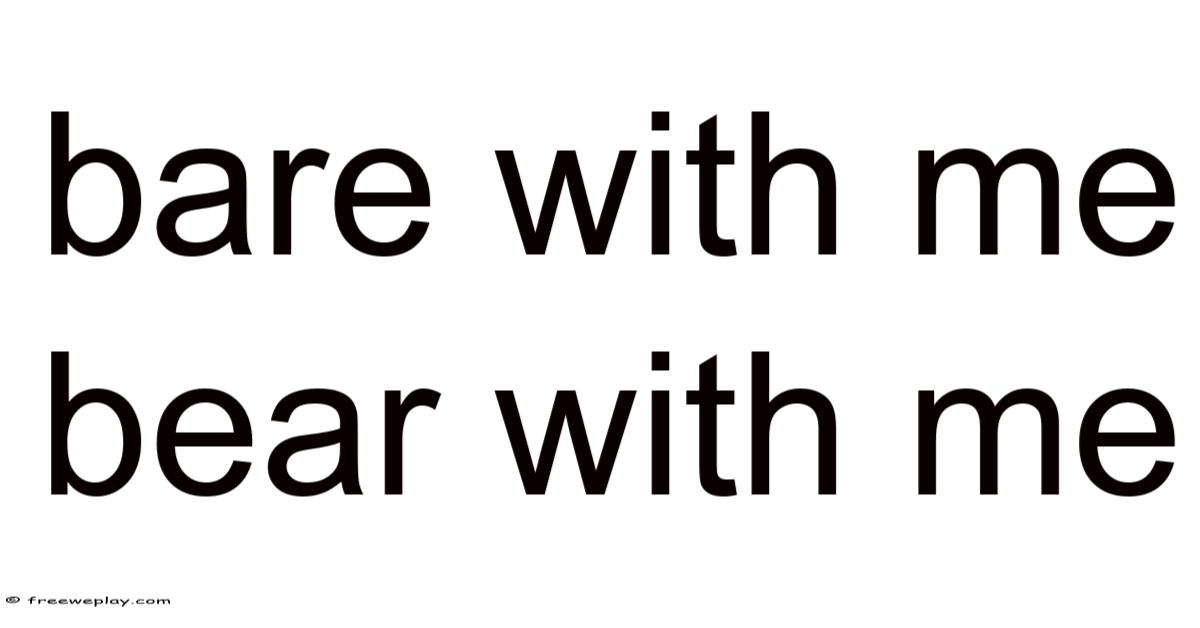
Bare With Me vs. Bear With Me: Understanding the Difference and Using Them Correctly
Introduction
Have you ever paused while typing an email or a text message, wondering whether you should use "bare with me" or "bear with me"? While they sound identical when spoken aloud, these two phrases carry vastly different meanings. Using the wrong one can transform a polite request for patience into an accidental—and potentially embarrassing—suggestion to undress. Understanding the distinction between these two homophones is essential for anyone looking to maintain professional communication and grammatical precision.
In this thorough look, we will explore the linguistic nuances of "bear with me" and "bare with me," explaining why one is a common idiom for patience and the other is a literal description of exposure. By the end of this article, you will not only know which phrase to use in a professional setting but also understand the etymology and logic behind the usage, ensuring you never make this common mistake again.
Detailed Explanation
To understand the difference between these two phrases, we must first look at the definitions of the verbs "bear" and "bare." Despite their identical pronunciation, they are distinct words with entirely different functions in the English language Turns out it matters..
"Bear" is a versatile verb with several meanings. In the context of the phrase "bear with me," it means to endure, tolerate, or be patient. When you ask someone to "bear with you," you are essentially asking them to tolerate a delay, a difficulty, or a long explanation. This usage stems from the idea of "bearing a burden." If you are asking someone to bear with you, you are acknowledging that the current situation might be tedious or frustrating, and you are requesting their grace and patience while you resolve the issue.
"Bare," on the other hand, is primarily used as an adjective or a verb meaning to uncover, expose, or strip something. As a verb, "to bare" means to reveal something that was previously hidden. As an example, if a dog "bares its teeth," it is exposing them as a sign of aggression. If someone "bares their soul," they are revealing their deepest secrets. Because of this, if you tell someone to "bare with me," you are literally asking them to get naked with you. Unless you are in a very specific, intimate, or medical context, this is almost certainly not what you intend to communicate.
The confusion typically arises because English is filled with homophones—words that sound the same but have different spellings and meanings. In the fast-paced world of digital communication, many people rely on phonetic spelling rather than grammatical rules, leading to the widespread misuse of "bare" in place of "bear." Still, in professional writing, this error can undermine your credibility and distract the reader from your actual message And that's really what it comes down to..
Concept Breakdown: How to Choose the Right Word
Choosing the correct phrase depends entirely on your intention. To ensure you are using the right word, you can follow a simple logical flow based on the intended meaning of your sentence Small thing, real impact..
The Logic of "Bear With Me"
When you use the word bear, you are referring to the act of carrying a load or enduring a situation. Think of the phrase "bearing the weight of the world." When you ask a client to "bear with me while I find that file," you are asking them to carry the "weight" of the wait time.
Key indicators that you should use "bear" include:
- You are asking for patience.
- You are dealing with a delay.
- You are explaining a complex topic that takes time to articulate.
- You are apologizing for a technical glitch.
The Logic of "Bare With Me"
When you use the word bare, you are referring to exposure or nudity. This word is almost always associated with removing a covering. Because "bare" is about revelation and openness, it does not fit the context of patience or endurance Turns out it matters..
Key indicators that you are using "bare" (and why it's likely wrong in a request for patience) include:
- The sentence implies uncovering something.
- The sentence refers to nakedness.
- The sentence describes stripping away a layer.
If your goal is to ask someone to wait a moment, "bare" is never the correct choice. The only time "bare with me" would be grammatically correct is if you were inviting someone to join you in a state of undress, which is rarely the intent of a business email or a casual conversation about a project.
Real Examples
To see how these phrases function in the real world, let's look at several scenarios. These examples highlight how the meaning of a sentence shifts dramatically based on a single vowel.
Professional Scenario: The Technical Glitch
Imagine you are presenting a slide deck during a Zoom meeting, and your screen freezes. You want to tell your colleagues that you are fixing the issue and they should wait a moment.
- Correct: "Please bear with me for a moment while I restart my computer." (This tells your colleagues to be patient.)
- Incorrect: "Please bare with me for a moment while I restart my computer." (This suggests you want your colleagues to undress while you reboot your PC.)
Academic Scenario: The Complex Explanation
A professor is explaining a difficult quantum physics concept and realizes the explanation is becoming convoluted. They want the students to stay focused despite the complexity Simple as that..
- Correct: "Bear with me as I walk through this formula; it's a bit complex, but it will make sense by the end." (This asks the students to endure the difficulty of the lesson.)
- Incorrect: "Bare with me as I walk through this formula." (This creates a highly inappropriate and confusing request in a classroom setting.)
Literal Usage of "Bare"
To understand "bare" in its correct form, consider these examples:
- "The hiker had to bare his skin to apply the antiseptic to the wound."
- "The winter wind left the branches of the oak tree bare."
- "She decided to bare her heart in her latest poetry collection."
In these instances, the word "bare" is used correctly because it refers to exposure or openness, not patience.
Theoretical Perspective: The Etymology of "Bear"
From a linguistic perspective, the verb "bear" comes from the Old English beran, which means to carry, bring, or produce. This root is why we use "bear" in so many different contexts: bearing children (producing), bearing a burden (carrying), and bearing a witness (bringing evidence) Took long enough..
Real talk — this step gets skipped all the time Most people skip this — try not to..
The phrase "bear with me" is an extension of the "carrying" definition. When you ask someone to bear with you, you are asking them to "carry" the burden of the inconvenience you are causing. The psychological principle here is one of social reciprocity; you are acknowledging the inconvenience and asking for a small amount of emotional labor (patience) from the other person Simple, but easy to overlook..
Conversely, "bare" comes from the Old English bær, meaning uncovered or naked. The transition from an adjective (a bare room) to a verb (to bare one's soul) maintains that core theme of exposure. Because the two words have entirely different ancestral roots, they have no conceptual overlap. One is about strength and endurance, while the other is about visibility and exposure.
Worth pausing on this one.
Common Mistakes and Misunderstandings
The most common mistake is the "phonetic trap." Because "bear" (the animal) and "bear" (to endure) and "bare" (naked) all sound exactly the same, the brain often defaults to the shortest or most common spelling it remembers Small thing, real impact..
The "Bear" Animal Confusion
Some people hesitate to use "bear" because they think of the large mammal. They imagine a grizzly bear and feel that using that word in a sentence about patience is nonsensical. Even so, English frequently uses the same spelling for different meanings (homonyms). The animal "bear" and the verb "bear" are spelled the same but have different origins. Do not let the image of a forest animal stop you from using the correct verb.
The "Bare" as "Basic" Confusion
Another misunderstanding occurs when people confuse "bare" with "barely." As an example, someone might think that "bare with me" means "stay with me in a bare/simple way." This is a grammatical fallacy. "Bare" as an adjective means empty or uncovered; it does not function as a synonym for "simply" or "just" when used as a verb in this phrase Most people skip this — try not to..
FAQs
Q: Is "bear with me" formal or informal? A: It is appropriate for both. It is a polite, standard phrase used in professional emails, formal presentations, and casual conversations. It is a softer way of saying "Wait a second" or "Be patient."
Q: What are some alternatives to "bear with me" if I'm worried about the mistake? A: If you are unsure, you can use phrases such as:
- "Thank you for your patience."
- "Please hold on for a moment."
- "I appreciate your patience while I resolve this."
- "Please stay with me as I explain this."
Q: Does "bear with me" always mean "wait"? A: Usually, but it can also mean "listen closely" or "follow my logic." Take this: if you are telling a long story with many tangents, you might say, "Bear with me here," meaning "Keep following my train of thought even though it's winding."
Q: Can "bare" ever be used in a phrase similar to "bear with me"? A: Only in a literal sense. To give you an idea, if a doctor tells a patient to "bare your arm" for an injection, they are asking for exposure. But in the context of patience, "bare" is always incorrect Simple as that..
Conclusion
Mastering the difference between "bear with me" and "bare with me" is a simple but powerful way to polish your communication. Consider this: while it may seem like a minor detail, the difference in meaning is extreme. One is a request for kindness and patience, while the other is a request for nudity That's the part that actually makes a difference..
To summarize: use bear when you want someone to endure a delay or a complex explanation. That said, use bare when you are talking about uncovering or exposing something. Even so, by remembering that "bear" is about carrying a burden, you can confirm that your professional correspondence remains polished and your intentions are clearly understood. Taking the time to get these homophones right demonstrates attention to detail—a trait that is highly valued in any academic or professional environment That's the whole idea..
