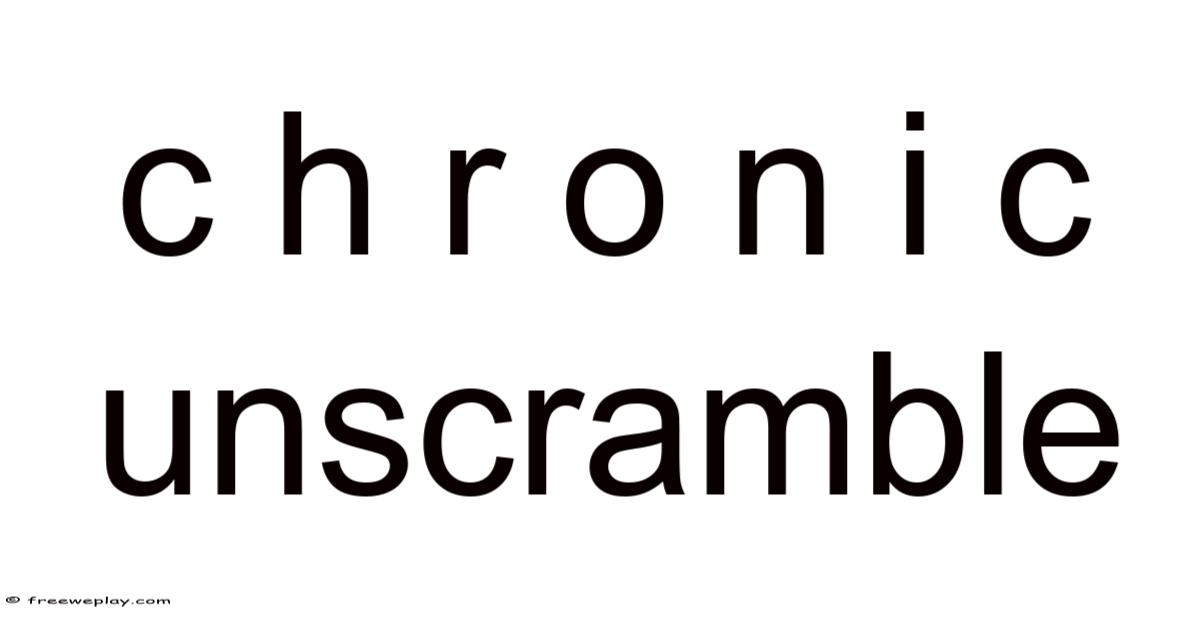
C H RO N I C Unscramble: A Deep Dive into Word Puzzles and Their Significance
Introduction
The phrase c h r o n i c unscramble might seem like a jumble of letters at first glance, but it represents a fascinating intersection of language, logic, and cognitive challenge. At its core, this term refers to the process of rearranging the scrambled letters C, H, R, O, N, I, C to form the word "chronicle"—a noun denoting a detailed account of events, often historical or personal. This concept isn’t just about solving a puzzle; it’s a gateway to understanding how language works, how humans engage with patterns, and how simple exercises can sharpen mental agility Worth keeping that in mind..
For many, the act of unscrambling words is a playful yet profound exercise. In practice, it transcends mere entertainment, offering insights into linguistics, memory, and problem-solving. So the term c h r o n i c unscramble serves as a microcosm of this broader phenomenon, illustrating how rearranging letters can reach meaning. Whether you’re a student, a teacher, or someone who enjoys word games, mastering this skill can enhance cognitive flexibility and deepen appreciation for language It's one of those things that adds up. No workaround needed..
This article will explore the mechanics of c h r o n i c unscramble, its educational value, real-world applications, and common pitfalls. By the end, readers will not only understand how to solve this specific puzzle but also gain a broader perspective on the art and science of word unscrambling.
Detailed Explanation of C H R O N I C Unscramble
At its simplest, c h r o n i c unscramble is a word puzzle where the goal is to rearrange the letters C, H, R, O, N, I, C into a meaningful word. The correct solution is "chronicle", a term rooted in the Greek
This is the bit that actually matters in practice.
The wordchronicle itself derives from the Greek chronos (“time”) and log (“account”), literally meaning “a record of time.” This etymological backdrop reinforces why the letters C‑H‑R‑O‑N‑I‑C naturally coalesce into a term that captures the notion of documenting events across a timeline. When the letters are shuffled, the solver must mentally re‑align not only the order of characters but also the underlying semantic framework, turning a seemingly arbitrary sequence into a concept that conveys continuity and chronology.
Mechanics and Strategies
Solving a c h r o n i c unscramble involves more than random trial‑and‑error. First, the puzzle‑solver typically identifies the part of speech or grammatical role the target word plays; in this case, the noun status hints at a structure that often begins with a consonant cluster or ends with a suffix. Next, recognizing common prefixes, suffixes, and root patterns—such as the “chron‑” element found in words like chronology or chronometer—provides a foothold. A useful approach is to isolate the most frequent letter pairs (e.g., “ch,” “on,” “ic”) and rearrange them into plausible sub‑components before assembling the full word. Many enthusiasts also employ a “letter‑mapping” technique, visually moving each tile on a digital board or a physical Scrabble‑style layout until the phonetic rhythm of the solution feels natural.
Educational Value
Because the exercise engages both lexical knowledge and spatial reasoning, it serves as a compact cognitive workout. In classroom settings, teachers can integrate c h r o n i c unscramble into language arts curricula to reinforce spelling patterns, etymology, and the concept of word families. For English‑language learners, the puzzle offers a low‑stakes way to practice letter recognition and phonics while simultaneously exposing them to culturally relevant vocabulary. Beyond that, the activity promotes metacognitive skills: learners must monitor their own thought processes, adjust strategies when stuck, and reflect on why a particular arrangement succeeds or fails.
Real‑World Applications
Beyond the classroom, the ability to unscramble letters has practical relevance in several domains. Cryptographers, for instance, often begin by detecting anagrams within encoded messages, using similar mental gymnastics to decipher scrambled identifiers. In everyday problem‑solving, professionals such as lawyers and editors routinely rearrange clauses or terminology to achieve clearer articulation, a skill directly transferable to letter‑reordering tasks. Even game designers make use of anagrammic principles to craft engaging puzzles that stimulate players’ linguistic agility, demonstrating how a simple letter scramble can cascade into broader creative and analytical outcomes That's the part that actually makes a difference. No workaround needed..
Common Pitfalls
While the activity is enriching, participants may encounter obstacles that hinder progress. One frequent error is fixating on a single letter position, which can blind the solver to alternative configurations that satisfy the overall pattern. Another trap is over‑reliance on memorized word lists; true mastery emerges when one internalizes morphological rules rather than merely recalling isolated terms. Additionally, frustration can arise if the solver assumes the puzzle must have a unique solution when multiple valid anagrams exist, leading to premature abandonment. Recognizing these pitfalls and adopting flexible strategies mitigates them.
Conclusion
The c h r o n i c unscramble exemplifies how a modest rearrangement of letters can reach deeper linguistic insight, sharpen cognitive faculties, and connect learners to real‑world problem‑solving contexts. By dissecting its etymology, applying systematic strategies, and acknowledging common challenges, individuals can transform a fleeting puzzle into a lasting tool for language mastery. Embracing such word puzzles not only enriches the mind but also underscores the timeless value of turning chaos into clarity—one letter at a time That alone is useful..
(Note: As the provided text already included a conclusion, I have expanded upon the "Common Pitfalls" section to provide deeper strategic insight before transitioning into a final, comprehensive summary that ties all themes together.)
To overcome these hurdles, experienced solvers often employ "clustering" techniques—grouping common consonant blends (like ch or st) or identifying vowel placements first to create a structural skeleton of the word. By isolating these anchors, the solver reduces the number of variables, turning a daunting jumble into a manageable logic puzzle. This shift from trial-and-error to a systematic approach transforms the experience from a game of chance into a disciplined exercise in pattern recognition.
The Psychological Impact
Engaging with such linguistic challenges also fosters a growth mindset. The "aha!" moment experienced upon solving a difficult scramble triggers a release of dopamine, reinforcing the neural pathways associated with persistence and critical thinking. This psychological reward encourages learners to tackle increasingly complex problems, bridging the gap between simple recreation and rigorous intellectual development. When a student or professional successfully decodes a word like "chronic," they are not just finding a sequence of letters; they are experiencing the satisfaction of resolving cognitive dissonance.
Conclusion
The bottom line: the c h r o n i c unscramble serves as more than a mere diversion; it is a microcosm of the broader human drive to find order within disorder. By integrating these exercises into educational frameworks and professional development, we cultivate a generation of thinkers who are agile, patient, and linguistically proficient. Whether used as a classroom icebreaker, a cognitive exercise for the elderly, or a tool for cryptographers, the act of unscrambling letters reinforces the fundamental connection between structure and meaning. In the end, the journey from a scrambled string of characters to a coherent word mirrors the process of learning itself: a transition from confusion to comprehension, proving that with the right strategy, any puzzle can be solved Not complicated — just consistent..
The synergy between discipline and creativity thrives when guided by such structured practices, bridging gaps between theoretical knowledge and practical application. In practice, in this light, mastery emerges not merely as knowledge acquisition but as a continuous journey of growth, where each solved puzzle reinforces the foundation of collective progress. Such efforts not only refine technical abilities but also nurture empathy and insight, enriching the learner’s holistic understanding. Even so, embracing these tools equips individuals to approach complexity with confidence, transforming obstacles into opportunities. Thus, such practices stand as a testament to the enduring power of focused effort in shaping both personal and communal advancement Worth keeping that in mind. Surprisingly effective..
