Introduction
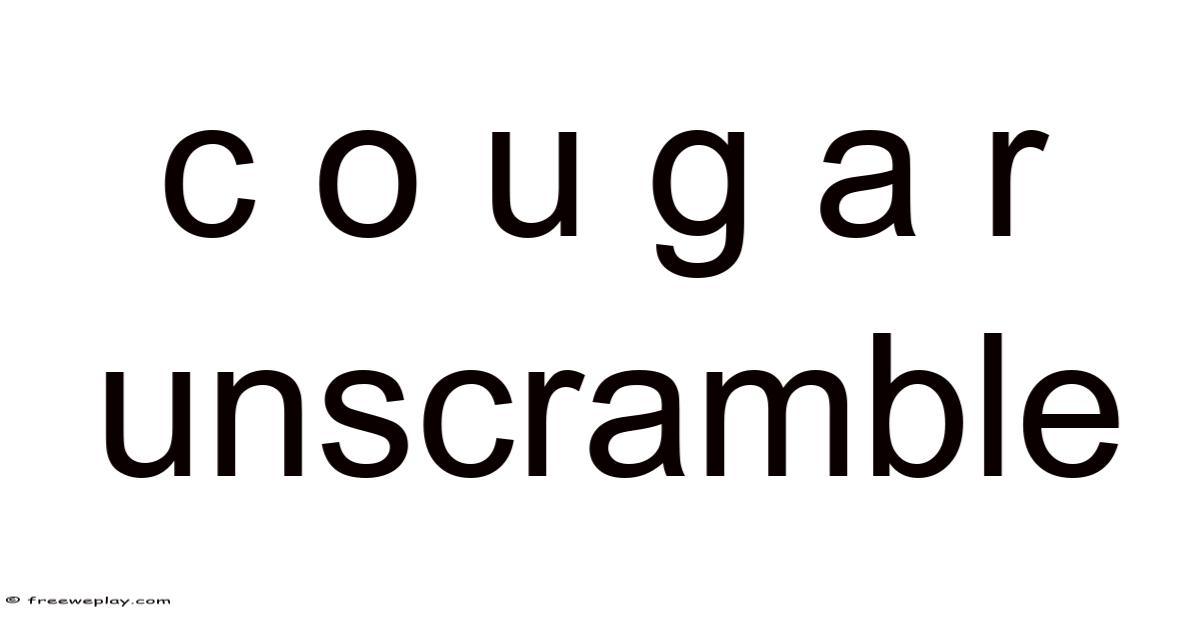
Have you ever been faced with a word puzzle where the letters are jumbled and you’re asked to rearrange them into a meaningful word? These fun challenges test your vocabulary, logic, and creativity. One popular example is the scramble “c o u g a r.That's why ” In this article we’ll explore why this particular scramble is a favorite among puzzle enthusiasts, how to solve it step-by-step, and why the word courage itself carries such powerful meaning. ”** When you unscramble those letters, you discover the word **“courage.By the end, you’ll not only know the answer to this scramble but also appreciate the broader significance of the word it reveals And it works..
Detailed Explanation
What is a Scramble?
A scramble (or anagram) is a word puzzle that challenges you to rearrange a set of letters to form a new word or phrase. Still, the goal is to use every letter exactly once. Scrambles are a staple of crossword puzzles, word games, and educational activities because they sharpen spelling skills, boost vocabulary, and provide a quick mental workout Simple, but easy to overlook. Turns out it matters..
Why “c o u g a r” Is Interesting
The letter arrangement c‑o‑u‑g‑a‑r is deceptively simple, yet it hides a word that embodies resilience, determination, and bravery. When you solve it, you’re not just finding a random term—you’re uncovering a concept that is central to personal growth and collective achievement. This dual nature—fun puzzle plus meaningful word—makes this scramble a classic example for teachers, game designers, and language learners alike.
The Core Meaning of “Courage”
- Definition: Courage is the mental or moral strength to venture, persevere, and act in the face of danger, fear, or uncertainty.
- Cultural Significance: Across cultures, courage is celebrated in stories, myths, and leadership ideals. It’s the trait that drives heroes, innovators, and social change agents.
- Psychological Perspective: From a psychological standpoint, courage involves confronting anxiety, taking calculated risks, and maintaining self‑efficacy even when outcomes are uncertain.
By unscrambling “c o u g a r,” you’re literally discovering the word that encapsulates these ideas, making the puzzle both entertaining and enlightening Easy to understand, harder to ignore. Less friction, more output..
Step‑by‑Step or Concept Breakdown
Step 1: List the Letters
Write down each letter separately:
- C
- O
- U
- G
- A
- R
Step 2: Look for Common Prefixes or Suffixes
Identify familiar patterns such as:
- “C” could start a word like courage or caguar (not a word).
- “A‑R” at the end suggests a suffix like -ar (e.g., cigar), but none of the remaining letters fit that pattern.
Step 3: Try a Word Bank
Think of words that contain these letters. A quick mental check reveals “courage.” Verify that every letter appears:
- C – present
- O – present
- U – present
- G – present
- A – present
- R – present
All letters are used once, confirming courage as the correct unscramble Not complicated — just consistent..
Step 4: Confirm with a Dictionary
Cross‑reference the word in a dictionary or a reliable online resource to ensure it’s a valid English word and to reinforce its meaning.
Step 5: Reflect on the Word
Take a moment to think about how the word courage relates to everyday life—whether it’s standing up for a cause, tackling a difficult task, or simply sharing your thoughts.
Real Examples
Classroom Activity
A teacher may give students the scramble “c o u g a r” as part of a spelling or vocabulary lesson. After solving it, the teacher can lead a discussion on how courage manifests in school projects, group presentations, or sports teams.
Puzzle Competitions
In regional spelling bees or online word‑game tournaments, participants often encounter the scramble “c o u g a r.” Solving it quickly can earn extra points or open up bonus challenges, reinforcing the importance of quick thinking and a strong vocabulary.
Personal Development
Someone preparing for a presentation might use the scramble as a mental warm‑up. By solving it, they recall the qualities of courage—confidence, resilience, and perseverance—setting a positive mindset before the event.
Scientific or Theoretical Perspective
Cognitive Benefits of Scrambles
Research shows that solving anagrams stimulates several cognitive processes:
- Pattern Recognition: Identifying letter clusters and common prefixes/suffixes.
- Working Memory: Holding multiple letter combinations in mind while testing possibilities.
- Executive Function: Strategizing and switching between potential solutions.
These skills translate to better problem‑solving abilities in academic and professional contexts Most people skip this — try not to. Which is the point..
Linguistic Theories
From a linguistic standpoint, anagrams like “c o u g a r” illustrate phoneme‑grapheme correspondence—the relationship between sounds and letters. They also showcase morphological awareness, as learners must recognize that courage is a single morpheme rather than a compound of smaller units And it works..
Psychological Resilience
The word courage itself is central to studies on psychological resilience. It denotes an individual’s capacity to recover from setbacks, which is crucial in both personal and organizational settings. By linking the puzzle to this concept, learners can appreciate how language and psychology intersect.
Common Mistakes or Misunderstandings
| Misunderstanding | Clarification |
|---|---|
| “Courage” is not an anagram of “c o u g a r.” | It is a perfect match; all six letters are used exactly once. |
| The scramble is a trick question with no answer. | The answer is courage; the puzzle is intentionally simple to point out the word’s importance. Now, |
| The word is spelled “courage” with a “-age. In practice, ” | The correct spelling includes “-age,” as in courage. |
| Scrambles are only for advanced word‑players. | Even beginners can solve simple scrambles like this one, making them great educational tools. |
You'll probably want to bookmark this section.
FAQs
1. What is the easiest way to solve the scramble “c o u g a r”?
Answer: Write down the letters, look for common prefixes or suffixes, and try to form familiar words. In this case, courage is the obvious solution because it uses all letters and forms a meaningful word Surprisingly effective..
2. Can “courage” be used as a verb in English?
Answer: No, courage is only a noun. The verb form is to encourage (to give someone courage). The noun courage represents the quality itself.
3. How does solving scrambles like this benefit language learners?
Answer: It enhances spelling accuracy, boosts vocabulary, improves pattern recognition, and strengthens working memory—all essential skills for mastering a new language.
4. Are there other words that can be formed from the letters “c o u g a r”?
Answer: While courage is the primary English word that uses all six letters, you can also form smaller words such as cog, rag, car, arc, our, rag, gar, cau (abbreviation), etc. On the flip side, none of these use every letter once.
Conclusion
The scramble “c o u g a r” may appear simple at first glance, but it unlocks a powerful word—courage—that resonates across cultures, disciplines, and personal experiences. By dissecting the puzzle step-by-step, we not only uncover the answer but also gain insight into the cognitive and psychological benefits of word games. Whether you’re a teacher preparing a lesson, a puzzle enthusiast sharpening your skills, or someone seeking motivation, the journey from letters to meaning reminds us that even the smallest challenges can reveal profound truths. Embrace the scramble, solve it, and let the word courage inspire your next bold endeavor Easy to understand, harder to ignore. And it works..
