Introduction
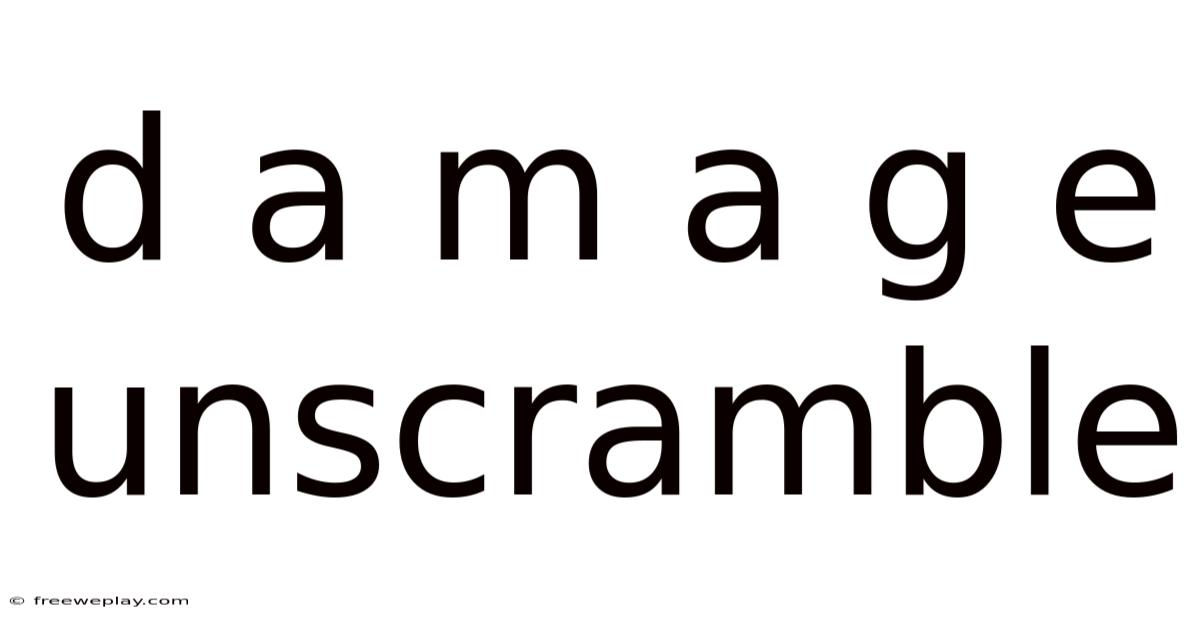
Have you ever stumbled upon a jumbled set of letters like “d a m a g e” and wondered how to turn it into a meaningful word? In this article we’ll explore everything you need to know about the “d a m a g e” unscramble: what it means, why it matters, how to solve it step‑by‑step, and what common pitfalls to avoid. This seemingly simple puzzle is a classic example of a letter‑unscrambling challenge, a brain‑teasing activity that appears in word games, crossword clues, and even classroom spelling exercises. By the end, you’ll not only be able to decode this particular scramble instantly, but you’ll also have a solid toolbox for tackling any future anagram or word‑shuffle puzzle with confidence.
Detailed Explanation
What is an “unscramble” puzzle?
An unscramble puzzle (also called an anagram) presents a collection of letters in a random order and asks the solver to rearrange them to form a valid word or phrase. Practically speaking, the core principle is simple: the letters remain the same; only their positions change. Here's the thing — this type of puzzle taps into two cognitive skills simultaneously—vocabulary knowledge and pattern recognition. When you see “d a m a g e,” your brain scans for familiar letter groupings, common prefixes or suffixes, and possible word lengths The details matter here..
Why “d a m a g e” is a good example
The string “d a m a g e” contains six letters, including a repeated “a.” Its solution, damage, is a high‑frequency English word that appears in everyday conversation, academic texts, and technical manuals. Because the answer is a common word, the puzzle is accessible to beginners yet still useful for teaching strategies such as:
- Identifying root words (e.g., “dam” or “age”)
- Spotting common suffixes (the “‑age” ending)
- Recognizing vowel‑consonant patterns (CVCVCV)
Understanding how these cues work in a simple case builds a foundation for solving longer, more complex scrambles Most people skip this — try not to..
The role of context
In many word games—Scrabble, Words With Friends, crosswords, or mobile apps—the letters are presented without any surrounding clue. Still, contextual hints (a definition, a picture, or a sentence) can dramatically narrow the possibilities. For “d a m a g e,” a clue like “harm or injury” instantly points to the word damage. When no clue is given, you rely purely on linguistic intuition and systematic techniques, which we’ll detail next.
Step‑by‑Step or Concept Breakdown
Step 1 – Write the letters in a line
Start by jotting the letters without spaces: damage. Seeing them together helps you notice patterns that are hidden when the letters are spaced out.
Step 2 – Look for common prefixes and suffixes
English words often begin or end with recognizable fragments. In our set:
- Suffix “‑age” is extremely common (e.g., courage, package, storage).
- Prefix “dam‑” appears in words like damage, damper, damask.
If you spot a suffix first, you can lock those letters in place and focus on the remaining letters.
Step 3 – Arrange the remaining letters
After fixing the suffix “‑age,” you are left with d, m, a. Test possible orders:
- dam + age → damage (makes sense)
- mad + age → madage (nonsense)
Only damage yields a real English word That's the part that actually makes a difference. Simple as that..
Step 4 – Verify the solution
Check the dictionary (or your mental lexicon) to ensure the formed word is valid. Damage is defined as “physical harm or injury to something,” confirming the solution.
Step 5 – Consider alternative words (optional)
Sometimes a scramble may have multiple valid solutions. , “listen” vs. g.Also, with “d a m a g e,” the only standard English word is damage. “silent”). Even so, in longer scrambles you might find alternatives (e.Always verify if more than one answer fits the given clue.
Real Examples
Example 1 – Classroom spelling activity
A teacher writes “d a m a g e” on the board and asks students to unscramble it within two minutes. And the activity reinforces spelling patterns (the “‑age” ending) and encourages quick mental reordering. After the correct answer appears, the teacher can discuss synonyms (harm, injury) and antonyms (repair, healing) to deepen vocabulary.
Example 2 – Mobile word game
In the popular app Wordscapes, a level may present the letters D A M A G E with a picture of a cracked windshield. Players must drag the letters to form damage to clear the level. The visual cue (the broken glass) serves as the contextual hint, making the puzzle easier for casual gamers Worth keeping that in mind. Simple as that..
Not the most exciting part, but easily the most useful.
Example 3 – Crossword clue
A crossword clue reads: “Harm, in a single word (6).That's why ” The answer length (6) matches the scramble, and the clue directly points to damage. Solvers who have practiced unscrambling will instantly see the connection between the clue and the letter set.
These examples illustrate that mastering the “d a m a g e” unscramble is not just an isolated skill; it translates to better performance in educational settings, recreational gaming, and everyday problem‑solving.
Scientific or Theoretical Perspective
Cognitive psychology of anagram solving
Research in cognitive psychology shows that solving anagrams engages the dual‑process theory of thinking:
- System 1 – fast, intuitive pattern recognition. When you glance at “d a m a g e,” your brain instantly flags the familiar “‑age” ending.
- System 2 – slower, analytical reasoning. You then consciously test possible arrangements of the remaining letters (d, m, a) to see which yields a legitimate word.
Studies using functional MRI have identified activation in the left inferior frontal gyrus (associated with language processing) and the parietal lobes (involved in spatial manipulation). The repeated practice of unscrambling strengthens neural pathways, improving overall verbal fluency and working memory Most people skip this — try not to..
Educational theory
From a pedagogical standpoint, unscrambling aligns with Vygotsky’s Zone of Proximal Development (ZPD). This incremental challenge promotes metacognitive awareness, as students learn to monitor their own strategies (looking for suffixes, counting letters, etc.So , 8‑letter anagrams) may require scaffolding—hints, word families, or collaborative discussion. g.Learners can solve simple scrambles like “d a m a g e” independently, but slightly more complex ones (e.).
Common Mistakes or Misunderstandings
| Mistake | Why it Happens | How to Fix It |
|---|---|---|
| Ignoring repeated letters | Overlooking that there are two “a”s can lead to dead‑ends (e.Think about it: | |
| Assuming any arrangement works | Believing that any random order forms a word leads to nonsense strings. Here's the thing — | |
| Over‑complicating with obscure words | Trying to force rare or archaic terms when a common word exists. | Count each letter before rearranging; write them in a list. Think about it: |
| Focusing only on prefixes | Some solvers look for a starting fragment and miss a suffix that is more telling. g.Consider this: | After forming a candidate, verify it against your mental dictionary or a word list. , trying “dgme”). |
No fluff here — just what actually works.
By being aware of these pitfalls, you can streamline your solving process and avoid frustration Small thing, real impact..
FAQs
1. Is “damage” the only possible word from the letters d a m a g e?
Yes, in standard English the only recognized six‑letter word using exactly those letters is damage. No other dictionary entry fits the letter count and composition.
2. How can I improve my speed at unscrambling letters?
Practice regularly with short puzzles, focus on recognizing common suffixes like ‑age, ‑ion, ‑ing, and play word games that force quick rearrangement. Over time, your brain will develop faster pattern‑matching pathways But it adds up..
3. Does the order of spaces matter (e.g., “d a m a g e” vs. “damage”)?
No. The spaces are merely a visual separator; the underlying letters remain the same. Whether the puzzle presents them spaced out or together, the solution does not change.
4. Can unscrambling be useful beyond games?
Absolutely. It enhances spelling proficiency, vocabulary acquisition, and problem‑solving skills—all valuable in academic writing, standardized tests, and even coding where you may need to parse jumbled strings.
Conclusion
The “d a m a g e” unscramble is more than a trivial brain teaser; it serves as a microcosm of the broader skills involved in anagram solving. Still, by understanding the concept, applying a systematic step‑by‑step approach, and being mindful of common mistakes, you can reliably transform the scrambled letters into the word damage in seconds. Worth adding, the cognitive and educational benefits—enhanced pattern recognition, stronger working memory, and richer vocabulary—extend far beyond the puzzle itself. Which means whether you’re a student sharpening spelling skills, a gamer seeking higher scores, or simply someone who enjoys wordplay, mastering this simple unscramble equips you with a versatile mental toolkit for countless linguistic challenges ahead. Keep practicing, stay curious, and let every scrambled set of letters become an opportunity to train your mind.
