Introduction
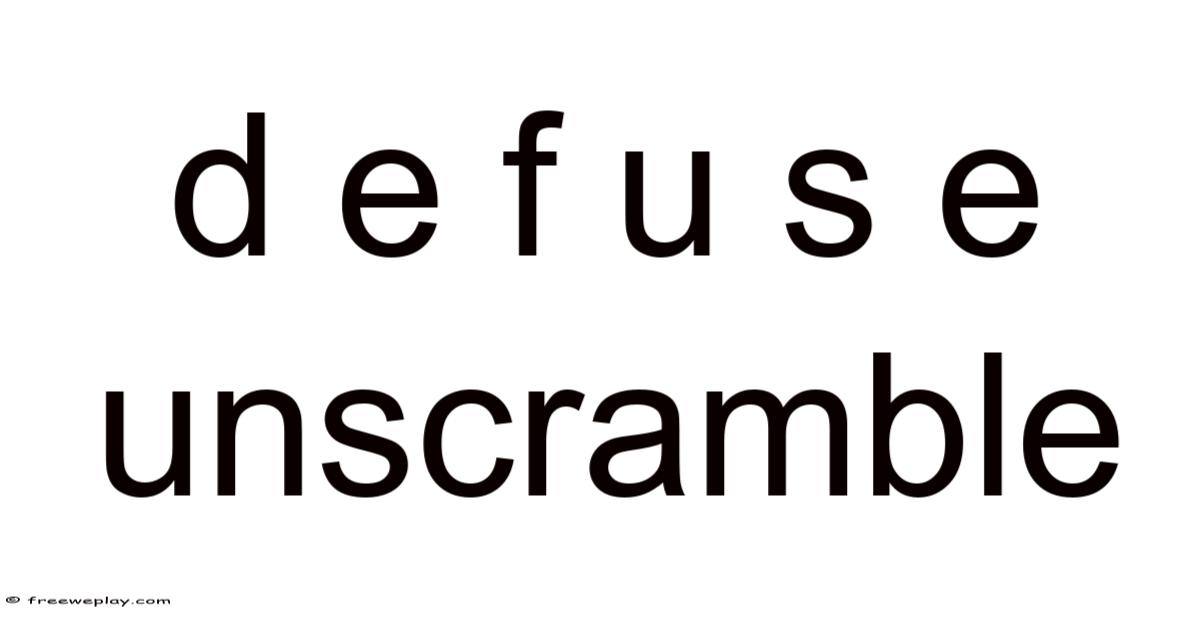
In the world of word puzzles, unscrambling is a favorite pastime that sharpens vocabulary and cognitive agility. One common challenge is to rearrange a jumbled string of letters to reveal a meaningful word. A classic example is the scramble “d e f u s e.” When you unscramble these six letters, you uncover the word “defuse.” Understanding how to approach such puzzles not only brings satisfaction but also enhances your problem‑solving skills. In this article we’ll dive deep into the art of unscrambling, explore strategies, and look at why the word “defuse” is a perfect illustration of the process.
Detailed Explanation
What is an Unscramble Puzzle?
An unscramble puzzle presents a set of letters that have been randomly reordered. The solver’s task is to rearrange them into a legitimate word or phrase. These puzzles range from simple three‑letter games to complex anagrams involving dozens of letters. The core challenge lies in recognizing patterns, phonetics, and word structure without seeing the final answer.
The Word “Defuse”
The letters d, e, f, u, s, e can be arranged in many ways, but only one arrangement forms a standard English word: defuse Most people skip this — try not to..
- Defuse means to make something less dangerous or to neutralize a threat, especially a bomb or explosive device.
- It is a verb that can also serve as a noun in contexts like “the defuse of the bomb.”
- The word comes from the French défuser (to blow apart) and has been in English since the late 19th century.
Why “Defuse” Makes a Great Unscramble Example
- Balanced Letter Distribution: The word contains a mix of vowels (e, u, e) and consonants (d, f, s), making it a moderate difficulty level.
- Common Usage: Many people encounter the word in media, safety training, or everyday conversation, so recognizing it can be rewarding.
- Educational Value: The process of unscrambling “defuse” teaches attention to letter placement, especially the placement of silent or doubled letters.
Step‑by‑Step or Concept Breakdown
1. Identify Vowels and Consonants
- Vowels: e, u, e
- Consonants: d, f, s
Count how many of each you have; this informs possible syllable patterns.
2. Look for Common Prefixes or Suffixes
- Possible Prefixes: “de‑” (as in “defeat”)
- Possible Suffixes: “‑use” (common in verbs like “use,” “reuse”)
3. Arrange the Core Letters
- Start with the prefix “de‑”.
- Place the remaining letters around it: d e f u s e → de‑f‑use.
4. Check for Validity
- Verify that the arrangement forms a recognisable word.
- Cross‑check with a dictionary if unsure.
5. Practice with Variations
- Try scrambling “defuse” again: f e d u s e → still “defuse.”
- Swap letters to see if another valid word emerges (e.g., “fused” is a valid word but requires rearranging to f u s e d; note that an extra “f” is needed, so not possible here).
Real Examples
1. Classroom Activity
Teachers often use unsolved scrambles like “d e f u s e” to build spelling skills. Students first identify the vowels, then guess the prefix, and finally complete the word. This exercise reinforces phonics and morphology.
2. Escape Room Scenarios
In themed escape rooms, players might encounter a locked box labeled with the scramble “d e f u s e.” Solving it reveals the word “defuse,” which then unlocks a safe containing a “defuser” tool. The puzzle blends linguistic skill with narrative immersion.
3. Mobile Gaming
Puzzle apps often feature a “Word Builder” mode where players drag letters to form words. “Defuse” appears as a mid‑difficulty word, encouraging players to practice rearranging consonant clusters But it adds up..
Scientific or Theoretical Perspective
Cognitive Processes Involved
- Pattern Recognition: The brain scans for familiar letter combinations.
- Working Memory: Temporary storage of letter arrangements to test different permutations.
- Executive Function: Planning and evaluating alternative solutions.
Research in psycholinguistics shows that solving anagrams activates the left inferior frontal gyrus, an area linked to language processing and problem solving. Regular practice can improve both linguistic fluency and executive control And that's really what it comes down to. Practical, not theoretical..
Linguistic Rules That Aid Unscrambling
| Rule | Example | Explanation |
|---|---|---|
| Suffix Frequency | “‑ing,” “‑ed,” “‑es” | Recognise common endings to guess word length. |
| Consonant Clusters | “st,” “tr,” “pl” | Certain clusters rarely appear together; spotting them narrows options. |
| Vowel Placement | “a‑e‑i‑o‑u” | Vowels often separate consonant clusters; their positions can hint at syllable breaks. |
Applying these rules systematically transforms a chaotic letter set into a structured search.
Common Mistakes or Misunderstandings
- Assuming Only One Word Is Possible
- Some scrambles yield multiple valid words. For “d e f u s e,” “fused” is a valid anagram, but the scramble includes an extra ‘f,’ so it’s not a direct match.
- Forgetting About Silent Letters
- Words like “knight” contain silent letters; overlooking them can mislead the solver.
- Over‑Rearranging
- Excessive permutations waste time. Focus on likely prefixes/suffixes first.
- Ignoring Context
- In themed puzzles, the context (e.g., a bomb defusal scenario) often hints at the correct word (“defuse” fits the theme better than “fused”).
FAQs
Q1: Can “defuse” be unscrambled into other valid English words?
A: The six letters of “defuse” can form fused and useful (if you add an “l”), but strictly using only the given letters, defuse and fused are the primary valid anagrams.
Q2: How does the difficulty of an unscramble puzzle scale?
A: Difficulty depends on letter count, presence of repeated letters, and commonness of the resulting word. A 6‑letter scramble like “defuse” is moderate; a 12‑letter scramble may be advanced, especially if the word is obscure Simple, but easy to overlook. That alone is useful..
Q3: What strategies help when I’m stuck on a scramble?
A:
- Break the set into smaller groups.
- Write down all vowels and consonants.
- Test common prefixes/suffixes.
- Use a word‑list or dictionary to confirm possibilities.
Q4: Is there a tool that can automatically unscramble words?
A: Yes, many online anagram solvers exist, but relying too heavily on them can hinder skill development. Use them sparingly for practice and verification.
Conclusion
Unscrambling the letters “d e f u s e” to reveal “defuse” exemplifies the blend of linguistic insight, pattern recognition, and logical reasoning that makes word puzzles enduringly popular. By mastering the steps—identifying vowels, spotting prefixes and suffixes, testing permutations, and validating against dictionary rules—you can tackle any scramble with confidence. Beyond entertainment, this skill sharpens cognitive functions, expands vocabulary, and nurtures a love for language. So next time you come across a jumbled set of letters, remember the process we’ve outlined and enjoy the satisfying moment when the correct word finally appears Took long enough..
