Introduction
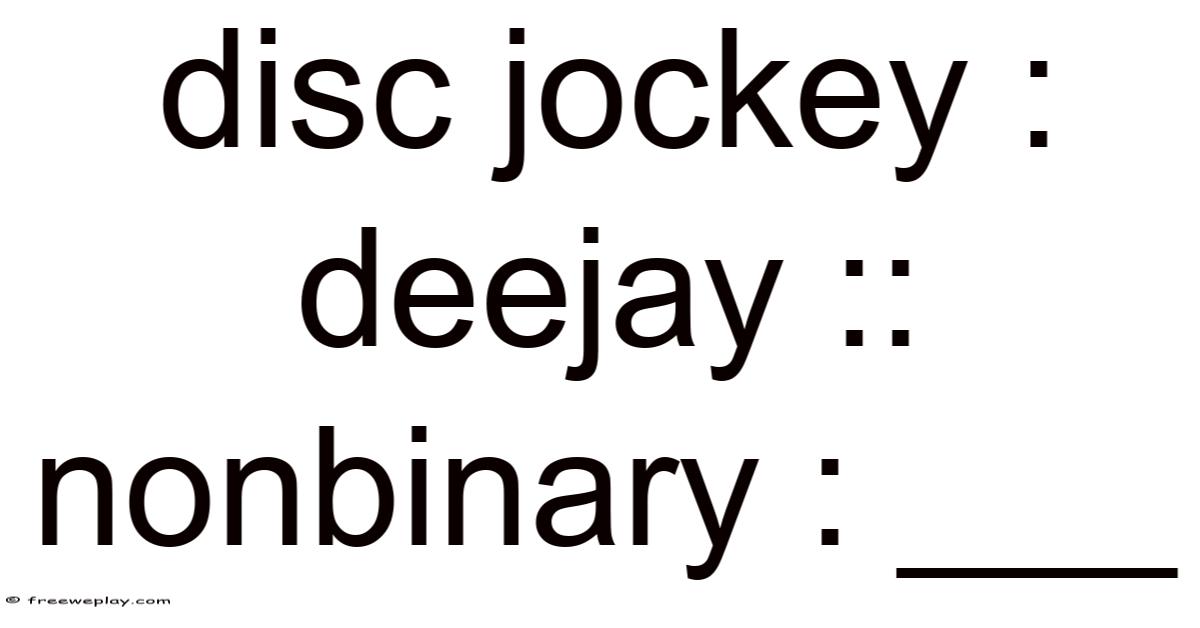
Imagine hearing the familiar crackle of a turntable, the beat dropping, and a skilled disc jockey guiding the crowd through a seamless musical journey. In everyday conversation, we often hear the term deejay used interchangeably with “disc jockey,” even though the two words originate from slightly different contexts. This linguistic parallelism invites us to ask: *if a disc jockey is to a deejay as a nonbinary identity is to ___, what term best completes the analogy?
In this article we will unpack the relationship between the two pairs, explore the cultural and theoretical underpinnings, and arrive at a clear, satisfying answer to the blank. By the end, you’ll not only understand why the analogy matters but also gain a richer perspective on how language shapes our view of gender and identity Simple, but easy to overlook..
Detailed Explanation
The phrase “disc jockey : deejay” sets up a classic role‑to‑person analogy. Even so, a disc jockey (often abbreviated “DJ”) is a professional who mixes recorded music, selects tracks, and reads the energy of a live audience. On top of that, the word deejay emerged in the 1970s as a shorthand for “disc jockey,” emphasizing the person rather than the equipment or the job title. In essence, deejay refers to the individual who performs the duties of a disc jockey.
When we turn to nonbinary, we encounter an identity that exists outside the traditional binary of male and female. Here's the thing — just as a deejay is the human embodiment of the disc jockey role, the term that mirrors nonbinary should denote the person who lives this identity. Nonbinary people do not exclusively identify as either man or woman; their gender experience may blend, fluctuate, or sit outside the binary spectrum entirely. That's why, the most natural completion of the analogy is nonbinary person—the individual who identifies as nonbinary Less friction, more output..
Real talk — this step gets skipped all the time.
Understanding this parallel is crucial because it highlights how language can either reinforce or challenge binary thinking. By recognizing that “deejay” is simply a person performing a DJ’s role, we can see that “nonbinary person” is simply a person whose gender identity does not conform to the binary. This framing respects both the role and the individual, fostering a more inclusive discourse.
Step‑by‑Step or Concept Breakdown
- Identify the first pair’s relationship – “disc jockey” denotes a role or function (mixing music, performing at events).
- Identify the second term in the pair – “deejay” is the person who fulfills that role; it is a shortened, colloquial version of “disc jockey.”
- Apply the same logic to the second pair – “nonbinary” is an identity or category describing a gender experience.
- Determine the analogous person‑term – the word that designates the individual who holds that identity. The straightforward choice is nonbinary person.
This step‑by‑step mapping shows that the analogy is not about synonyms or creative wordplay; it is about matching categories (role vs. individual). person, identity vs. By following this logical flow, we avoid vague or forced answers and arrive at a term that preserves the structural integrity of the original analogy.
This is where a lot of people lose the thread Simple, but easy to overlook..
Real Examples
To cement the concept, consider real‑world illustrations. Practically speaking, Kaskade, a world‑renowned disc jockey, is often referred to as a deejay when he headlines festivals, emphasizing his personal brand rather than his technical setup. Similarly, Sam Smith publicly identifies as nonbinary and is frequently called a nonbinary person in interviews, articles, and social media, underscoring that the identity is fundamentally about the individual Worth keeping that in mind..
The precision of this analogy extends beyond mere word choice, reflecting broader principles of inclusive communication. In practice, this linguistic framing combats dehumanization by emphasizing that identities are not monolithic traits but integral to a person’s lived reality. Just as "deejay" humanizes the technical role of a disc jockey, "nonbinary person" anchors the abstract concept of nonbinary identity in individual experience. Take this case: media coverage often defaults to reductive labels like "the nonbinary athlete," whereas specifying "nonbinary person" contextualizes the identity within their full humanity—acknowledging their skills, achievements, and complexities beyond gender.
On top of that, this parallel underscores the importance of agency in language. That said, while "disc jockey" and "nonbinary" describe categories, "deejay" and "nonbinary person" grant ownership to the individual. This distinction is critical in advocacy spaces, where self-identification empowers marginalized voices. Take this: LGBTQ+ organizations increasingly use "nonbinary person" in educational materials to reinforce that identity is self-determined, not externally imposed. By contrast, terms like "nonbinary individual" or "nonbinary human," though well-intentioned, risk diluting the analogy’s elegance by introducing unnecessary synonyms Not complicated — just consistent..
The analogy also highlights how language evolves to reflect social progress. Day to day, similarly, "nonbinary person" is gaining traction as the standard in academic, medical, and legal contexts—evidenced by recent style guides from institutions like the Associated Press. The shift from "disc jockey" to "deejay" mirrors the normalization of gender-inclusive terms, showing colloquial adaptations often precede formal acceptance. This evolution signals a collective move toward language that respects diversity without exoticizing or tokenizing identities Not complicated — just consistent..
In essence, the disc jockey/deejay and nonbinary/nonbinary person analogy is not merely a linguistic exercise but a tool for empathy. It teaches us that categories describe roles or experiences, but only people embody them. As language shapes perception, using "nonbinary person" ensures that gender diversity is discussed not as an abstract concept but as a fundamental aspect of human identity—worthy of the same respect and nuance we afford to artists like Kaskade or Sam Smith. By prioritizing terms that center individuals, we support dialogue that is both accurate and humane. This approach doesn’t just clarify communication; it builds bridges of understanding in a world where inclusivity begins with the words we choose And it works..
Not the most exciting part, but easily the most useful.
The ripple effects of this linguistic shift extend far beyond casual conversation, influencing institutional practices and interpersonal dynamics in profound ways. Schools adopting gender-inclusive policies now routinely use "nonbinary person" in official documentation, signaling to students that their identities are recognized and valued. Healthcare providers who mirror this language create environments where patients feel seen—not as medical curiosities but as whole individuals with distinct needs and experiences. Even corporate spaces are heeding the shift; employee resource groups increasingly specify "nonbinary person" in their outreach, moving away from sterile terminology that can inadvertently reinforce othering.
Yet the journey toward linguistic precision isn't without complexity. Some argue that insisting on person-first language inadvertently suggests that nonbinary identities are inherently problematic—that we must soften them with humanizing qualifiers. That said, this perspective overlooks how language functions as both mirror and architect of social reality. Which means when we say "nonbinary person," we're not apologizing for identity; we're asserting its normalcy within the full spectrum of human experience. The parallel with "deejay" is instructive here: no one suggests that "disc jockey" is more palatable because it sounds more clinical, yet both terms coexist because they serve different communicative purposes.
Some disagree here. Fair enough That's the part that actually makes a difference..
The digital age has accelerated this evolution in fascinating ways. Social media platforms, where users craft their own identities through chosen labels and pronouns, demonstrate how language adapts organically from the grassroots up. Here's the thing — tikTok creators who identify as nonbinary often introduce themselves simply as "nonbinary person" in their bios—not as a political statement, but as natural self-expression. This mirrors how "deejay" emerged from club culture before entering mainstream lexicon, carried by those who lived the identity rather than those who observed it from afar.
Looking ahead, the persistence of "nonbinary person" in evolving discourse will likely depend on whether institutions continue prioritizing lived experience over linguistic convenience. As younger generations become dominant voices in media, academia, and governance, terms that center individual agency rather than categorical abstraction will likely become the default—not through mandate, but through organic consensus about what feels both accurate and respectful.
At the end of the day, the true measure of this linguistic evolution lies not in style guides or policy documents, but in the quiet moments when someone hears their identity reflected back to them in language that honors their full humanity. Whether in a classroom, a workplace, or a headline, the choice between "nonbinary" as a thing and "nonbinary person" as an individual carries the weight of recognition—that each identity deserves not just acknowledgment, but the dignity of being spoken as precisely what it is: a declaration of who someone is, not just what they are.
