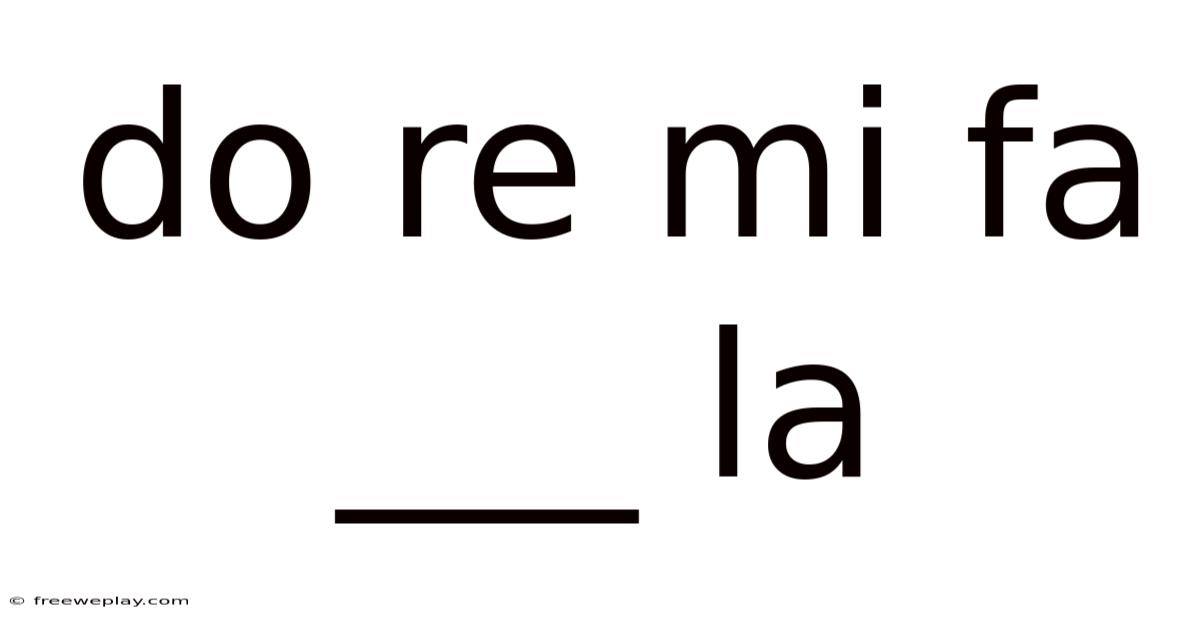
Do Re Mi Fa ___ La

Introduction
The phrase “do re mi fa ___ la” instantly transports many people to the opening notes of the classic Do‑Re‑Mi song from The Sound of Music. Yet, beyond its catchy melody, this fragment represents a fundamental building block of Western music: the solfege syllables that name the notes of a diatonic scale. In this article we will uncover what those syllables are, why they matter, and how they are used across genres, cultures, and educational systems. By the end, you’ll not only know the missing note—sol—but also appreciate the deeper theoretical and practical significance of the entire sequence.
Detailed Explanation
What is Solfege?
Solfege is a solfège system that assigns syllables to the seven notes of the major scale: do, re, mi, fa, sol, la, ti (or si in some countries). These syllables serve as a tonic‑based naming system, allowing musicians to read, sing, and internalize pitches without relying on letter names or complex notation. The system originated in medieval Europe with Guido of Arezzo, who derived the syllables from the Latin phrase “Ut queant laxis” (the first syllable of each line of a hymn to St. John). Over centuries, “ut” evolved into “do,” and the remaining syllables were retained, creating the familiar sequence we use today.
Context and Core Meaning
In a C‑major scale, the syllables map directly onto the notes:
- C → do
- D → re
- E → mi
- F → fa
- G → sol
- A → la
- B → ti (or si) When you hear “do re mi fa ___ la,” the blank is naturally filled by sol, the fifth degree of the scale. This pattern is not arbitrary; it reflects the stepwise construction of the major scale, where each successive note is either a whole step or a half step away, creating a predictable intervallic relationship that underpins melody, harmony, and improvisation.
Step‑by‑Step or Concept Breakdown 1. Identify the tonic (key note).
The tonic is the note that serves as the “home” of the scale. In our example, if the scale is C‑major, the tonic is C.
-
Assign solfege syllables in order.
Starting from the tonic, assign do to the first degree, re to the second, and so on until ti for the seventh. -
Fill the missing syllable.
In the phrase “do re mi fa ___ la,” the missing degree is the fifth of the scale, which is always sol. -
Sing or play the complete scale.
Using the syllables, you can sing do‑re‑mi‑fa‑sol‑la‑ti‑do, which reinforces pitch memory and interval recognition. 5. Apply to other keys. The same pattern works in any major key; only the tonic changes. For instance, in G‑major, the syllables become so‑la‑ti‑do‑re‑mi‑fa‑so.
This step‑by‑step approach makes solfege a versatile tool for both ear training and sight‑reading.
Real Examples
-
Children’s Music Education: In preschool classrooms, teachers often use a piano or xylophone to play each syllable while pointing to the corresponding key. Children repeat “do, re, mi…” until they can sing the entire scale unaided.
-
Professional Vocal Warm‑ups: Singers frequently perform “solfege scales” in thirds, fifths, or octaves to develop pitch accuracy. For example, singing mi‑sol‑ti‑do helps target the middle of the range.
-
Improvisation in Jazz: Improvisers may mentally map a blues scale onto solfege syllables to outline chord changes, ensuring that each note aligns with the underlying harmony.
-
Film Scores: The iconic opening of The Sound of Music literally uses the syllables “do‑re‑mi‑fa‑so‑la‑ti‑do” as a melodic motif, demonstrating how solfege can be both pedagogical and artistic.
These examples illustrate why the simple phrase “do re mi fa ___ la” carries weight far beyond a nursery rhyme.
Scientific or Theoretical Perspective
From a acoustic physics standpoint, each solfege syllable corresponds to a specific frequency ratio within the harmonic series. In equal temperament, the intervals are approximated as follows:
- Whole step (major second): ratio ≈ 9/8
- Half step (minor second): ratio ≈ 16/15
The sequence do‑re‑mi‑fa‑sol‑la‑ti thus represents a series of ascending intervals that approximate these ratios, creating a pattern that the human ear perceives as “stable” and “consonant.”
Neuroscientific studies show that solfege training activates the auditory cortex and motor planning areas simultaneously, reinforcing the link between perception and production. This dual engagement explains why children who learn solfege often develop better pitch discrimination and language skills compared to peers who rely solely on letter names.
Common Mistakes or Misunder
Building on this foundation, it’s important to address common challenges learners face when working with solfege. Many beginners struggle with matching the syllables to the correct note names, particularly when the phrase feels repetitive. To overcome this, pairing auditory practice with visual aids—such as a staff or digital audio—can solidify understanding. Additionally, incorporating rhythmic patterns into solfege exercises helps students internalize timing, making the transition from note names to sounds smoother.
Another valuable extension is integrating solfege into interactive apps or online platforms. Tools like Solfege Trainer or Pitch Perfect offer gamified lessons that adapt to individual progress, providing instant feedback and encouraging consistent practice. These technologies not only make learning enjoyable but also track improvement over time, fostering confidence.
Moreover, applying solfege beyond the classroom enriches real-world skills. Musicians often use these exercises to refine their diction, while language learners benefit from enhanced intonation and articulation. Educators should emphasize these cross-disciplinary benefits to highlight solfege’s versatility.
In conclusion, the journey through learning “do re mi fa ___ la” is more than a simple exercise—it’s a gateway to deeper musical intuition, cognitive development, and creative expression. By embracing this process, learners unlock not just notes, but a richer connection to music and language.
Conclusion: Mastering the sequence through repetition, rhythm, and technology transforms solfege from an abstract concept into a tangible skill, empowering learners across diverse contexts.
Beyond the basics,learners can expand their solfege toolkit by exploring movable‑do versus fixed‑do systems. In movable‑do, “do” always corresponds to the tonic of the current key, which reinforces functional hearing and makes transposition intuitive. Fixed‑do, where each syllable is permanently tied to a specific pitch (C‑do, D‑re, etc.), is especially useful for absolute‑pitch training and for reading music in languages that use syllable‑based notation. Practicing both approaches side‑by‑side sharpens the ability to shift between relative and absolute pitch perspectives, a skill that proves invaluable when sight‑reading complex scores or collaborating with musicians from different pedagogical traditions.
Chromatic solfege introduces altered syllables — such as “di” for a raised second and “ra” for a lowered second — allowing singers to navigate modulations and non‑diatonic passages with the same fluency they apply to the major scale. Incorporating these chromatic syllables into scale‑degree exercises, interval drills, and melodic dictation strengthens inner‑ear precision and reduces reliance on external reference tones during performance.
Ensemble contexts offer another fertile ground for solfege application. When choir members internalize solfege patterns, they can quickly lock onto harmonic entrances, anticipate voice‑leading movements, and blend timbres more effectively. Conductors often use solfege cues during rehearsals to correct intonation without breaking the musical flow, fostering a shared auditory language that transcends individual instrument timbres.
Technology continues to evolve the way solfege is taught and assessed. Adaptive learning platforms now employ machine‑learning algorithms to analyze a learner’s pitch accuracy in real time, offering personalized micro‑exercises that target specific trouble spots — such as consistently sharp “fi” or flat “se.” Virtual‑reality environments immerse students in interactive soundscapes where they must match solfege syllables to spatially rendered notes, reinforcing both auditory processing and spatial awareness.
Finally, the interdisciplinary reach of solfege extends into speech therapy and language acquisition. By training the vocal apparatus to produce precise pitch contours, individuals improve prosodic control, which aids in mastering tonal languages and enhances expressive reading. Educators who highlight these cross‑domain benefits motivate learners to view solfege not merely as a music‑class ritual but as a versatile cognitive tool.
Conclusion: Embracing the full spectrum of solfege — from foundational diatonic patterns to movable and fixed systems, chromatic extensions, ensemble practice, and cutting‑edge digital tools — transforms a simple syllable sequence into a powerful framework for musical fluency, linguistic agility, and lifelong artistic growth. Through deliberate, varied engagement, learners convert abstract theory into lived experience, unlocking deeper connections between sound, mind, and expression.
Latest Posts
Latest Posts
-
You Know I Cant Quite Remember Nyt
Mar 27, 2026
-
Layer Of The Upper Atmosphere Nyt
Mar 27, 2026
-
Halloween Words That Start With A
Mar 27, 2026
-
Three Letter Words That Start With K
Mar 27, 2026
-
What Does It Mean To Cut The Cheese
Mar 27, 2026
