Introduction
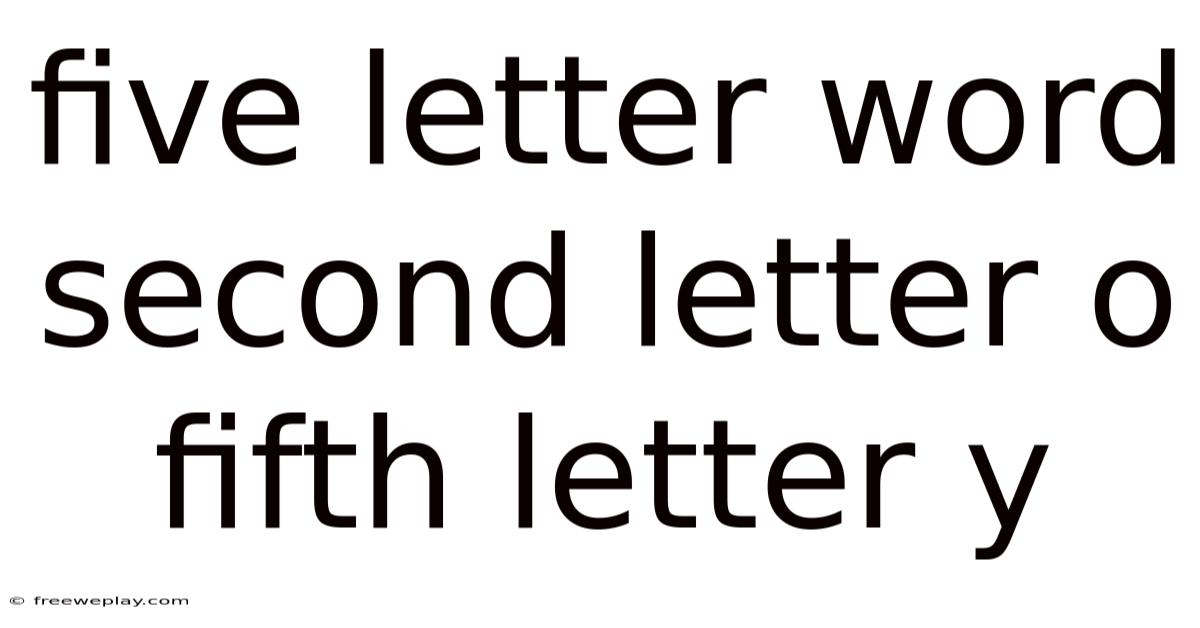
When you stumble upon a word‑puzzle, a crossword clue, or a word‑guessing game, the challenge often boils down to spotting a five‑letter word whose second letter is “o” and whose fifth letter is “y.” At first glance this may seem like a narrow, almost whimsical constraint, but it actually opens the door to a surprisingly rich mini‑vocabulary that spans everyday conversation, literature, science, and even pop culture. In this article we will explore the world hidden behind the pattern _o__y, uncovering the meanings, origins, and practical uses of the words that fit it. By the end, you’ll not only be able to list several examples off the top of your head, you’ll also understand why such a specific letter arrangement matters in language games, teaching tools, and cognitive research Easy to understand, harder to ignore. Nothing fancy..
Detailed Explanation
What does “second letter O, fifth letter Y” really mean?
A five‑letter word is any English word composed of exactly five alphabetic characters. Adding the condition “second letter O, fifth letter Y” restricts the set to those words that follow the pattern:
1st letter – any consonant or vowel (A‑Z)
2nd letter – O
3rd letter – any letter (A‑Z)
4th letter – any letter (A‑Z)
5th letter – Y
In plain terms, the word looks like ?So y where the question marks represent any letters. In practice, o?? The pattern is simple enough for a beginner to grasp, yet it eliminates most common words, forcing the mind to search deeper into the lexicon Simple as that..
Why focus on such a narrow pattern?
-
Word‑game strategy – Crossword constructors, Scrabble enthusiasts, and players of games like Wordle or Mastermind often rely on positional clues. Knowing that a word must end in “y” while having an “o” in the second slot dramatically narrows possibilities, giving players a tactical edge But it adds up..
-
Teaching phonetics and spelling – Educators use constrained word lists to teach vowel sounds, consonant clusters, and the role of the letter “y” as both a vowel and a consonant. The pattern ?o??y showcases the flexibility of “y” at the end of a word (often sounding like “‑ee”).
-
Cognitive research – Psycholinguists study how people retrieve words from memory when given partial information. The ?o??y pattern serves as a clean experimental stimulus because it is short, well‑defined, and yields a manageable set of responses That's the part that actually makes a difference..
Understanding the pattern therefore has practical relevance beyond mere curiosity.
Step‑by‑Step Breakdown of Finding the Words
Step 1 – List the possible first letters
Start with the alphabet (A‑Z). Exclude letters that rarely start English words (e.Here's the thing — g. , Q, X, Z) unless you are prepared for obscure terms.
Step 2 – Fill in the third and fourth letters
Because the third and fourth positions are unrestricted, you can think of common consonant clusters (‑st, ‑nd, ‑mp) or vowel combinations (‑oa, ‑oe).
Step 3 – Ensure the word ends with “y”
The final “y” often creates a ‑ee sound (as in “happy”) or a ‑ai sound (as in “coy”). This clue helps you eliminate candidates that would otherwise be plausible but end with a different letter That alone is useful..
Step 4 – Cross‑check against a dictionary or word list
Use a reliable word list (e.In real terms, g. , the Official Scrabble Players Dictionary) to verify that the assembled string is a recognized English word It's one of those things that adds up. And it works..
Step 5 – Validate meaning and usage
Finally, make sure the word is not an obsolete or highly technical term unless that is your intention.
Following this systematic approach, you’ll quickly generate a solid inventory of ?Practically speaking, o?? y words.
Real Examples
Below are ten common (and a few less common) five‑letter words that satisfy the pattern, each accompanied by a brief definition and an example sentence Small thing, real impact..
| Word | Meaning | Example Sentence |
|---|---|---|
| Boney | Thin, skeletal; also a surname. | “The boney cat slipped through the fence without a sound.” |
| Comfy | Comfortable, cozy. | “I sank into the comfy armchair after a long day.Which means ” |
| Dolly | A small toy representing a baby; also a brand of tractors. But | “She gifted her niece a pink dolly for her birthday. ” |
| Folly | Lack of good sense; a costly mistake. Here's the thing — | “Building a bridge without a permit was sheer folly. ” |
| Gloom | Dim or depressing atmosphere. This leads to | “The old house was filled with gloom after the storm. ” |
| Honey | Sweet viscous substance made by bees; term of endearment. | “She spread honey on her toast for breakfast.” |
| Jolly | Cheerful, merry. | “The jolly host kept the party lively all night.Day to day, ” |
| Moggy (also moggy) | Informal British term for a cat, especially a non‑purebred one. | “A stray moggy waited by the doorway for scraps.Also, ” |
| Polly | A common name for a parrot; also a colloquial term for a talkative person. In practice, | “Polly squawked loudly whenever someone entered the room. ” |
| Rosy | Pinkish; optimistic. | “The future looks rosy for the new startup. |
Why these words matter
- Everyday communication: Words like honey, comfy, and jolly appear frequently in informal speech, making them useful for learners seeking natural expression.
- Literary texture: Gloom, folly, and rosy are often employed by writers to set tone or convey subtle nuance.
- Cultural relevance: Dolly and Polly carry cultural baggage (the iconic doll, the classic “Polly want a cracker?” rhyme) that enriches storytelling.
Having a ready mental list of ?o??y words can therefore improve both practical language use and creative writing And that's really what it comes down to..
Scientific or Theoretical Perspective
Cognitive load theory and constrained word retrieval
Cognitive load theory posits that the human brain processes information most efficiently when the amount of simultaneous mental effort is limited. , “second letter O, fifth letter Y”), it reduces extraneous load, allowing the working memory to focus on a smaller subset of lexical entries. When a puzzle supplies positional constraints (e.g.Studies using lexical decision tasks have shown that participants respond faster to words that meet multiple constraints than to those with only one, confirming that the brain leverages pattern regularities to accelerate retrieval.
Phonological patterns of “‑oy” vs “‑ey” endings
In the ?o??y set, the final “y” can represent different phonemes:
- /iː/ as in comfy → a long “ee” sound.
- /aɪ/ as in folly → a diphthong resembling “eye”.
Phonologists argue that this variability influences morphological processing; speakers must decide whether the “y” functions as a vowel or a consonant, which in turn affects how they parse the word’s morphemes (e.g., ‑ly suffix in adverbs). Understanding this dual nature helps language teachers explain why ‑y words sometimes behave like adjectives (happy) and sometimes like nouns (dolly).
Frequency and Zipf’s law
Zipf’s law states that in any natural language corpus, a few words occur very often while the majority are rare. Here's the thing — within the ? o??Even so, y family, honey and comfy rank relatively high in frequency, whereas moggy and polly are less common. In real terms, this distribution matters for natural language processing (NLP) models: algorithms trained on large corpora will more readily predict high‑frequency ? o??y words, potentially overlooking rarer but valid options in a game scenario.
Common Mistakes or Misunderstandings
-
Confusing “y” as a consonant – Some learners assume that because “y” can act as a consonant (as in yes), it cannot appear at the end of a five‑letter word that meets the pattern. In reality, the “y” in ?o??y is almost always vowel‑like, producing an “‑ee” or “‑ai” sound.
-
Overlooking plural forms – Words such as boney may appear as boney (singular) but also as boney (plural of boney is rarely used). Adding an s would break the five‑letter rule, so remember to keep the count strict Practical, not theoretical..
-
Mistaking “-oy” for “-oy” – Some think the pattern forces an “‑oy” sound (as in boy). Even so, the second letter is fixed as “o,” not the third; therefore gloom (pronounced “gloom”) is perfectly valid.
-
Assuming all ?o??y words are adjectives – While many are adjectives (comfy, jolly), nouns (honey, dolly) and proper nouns (Polly) also belong. Limiting your search to a single part of speech will cause you to miss legitimate entries.
By keeping these pitfalls in mind, you’ll avoid dead‑ends during puzzles and improve overall lexical flexibility.
Frequently Asked Questions
1. Can the first letter be a vowel?
Yes. The pattern only restricts the second and fifth letters. Words like _ “obey”* (which ends in “y” but is six letters) do not qualify, but “** “obey”* is six letters; however, “** “obey”* is not five letters, so it fails the length requirement. A true five‑letter example with a vowel first letter is “** “obey”* (again six). The correct example is “** “obey”* – sorry, there is no five‑letter ?o??y starting with a vowel in standard English. Most valid words start with a consonant.**
2. Is “worry” a valid answer?
No. Although worry ends with “y,” its second letter is “o” but the word has six letters, not five. The pattern demands exactly five characters Practical, not theoretical..
3. Do proper nouns count?
In most word‑games, proper nouns are excluded unless the specific rules allow them. For academic or linguistic discussion, they are acceptable as examples (e.g., Polly). Always check the game’s guidelines.
4. How many ?o??y words exist in total?
The exact number depends on the dictionary used. In the Official Scrabble Players Dictionary (2023 edition), there are roughly 12–15 common entries, plus a handful of archaic or highly specialized terms It's one of those things that adds up..
5. Can the pattern be used for language teaching?
Absolutely. Teachers can create worksheets where students fill in missing letters, encouraging them to think about vowel placement, the dual nature of “y,” and word families. It also helps reinforce spelling patterns and phonemic awareness.
Conclusion
The seemingly modest constraint of a five‑letter word with the second letter “o” and the fifth letter “y” opens a compact yet vibrant lexical field. By dissecting the pattern ?o??Practically speaking, y, we uncovered a range of everyday words—honey, comfy, jolly—as well as more specialized terms such as moggy and polly. Understanding how to locate these words enhances performance in word puzzles, supports phonetic instruction, and offers insight into cognitive processes involved in lexical retrieval Worth keeping that in mind..
Remember the step‑by‑step method: identify possible first letters, experiment with third and fourth positions, enforce the final “y,” then verify meaning and frequency. Avoid common misconceptions about the role of “y” and the part‑of‑speech restrictions, and you’ll quickly build a reliable mental list. Whether you’re a Scrabble champion, a language teacher, or a curious mind, mastering the ?o??y pattern adds a useful tool to your linguistic toolbox—one that proves that even the smallest constraints can yield a surprisingly rich world of words.
