to make sure the article flows well and meets all the requirements. </think>
Introduction
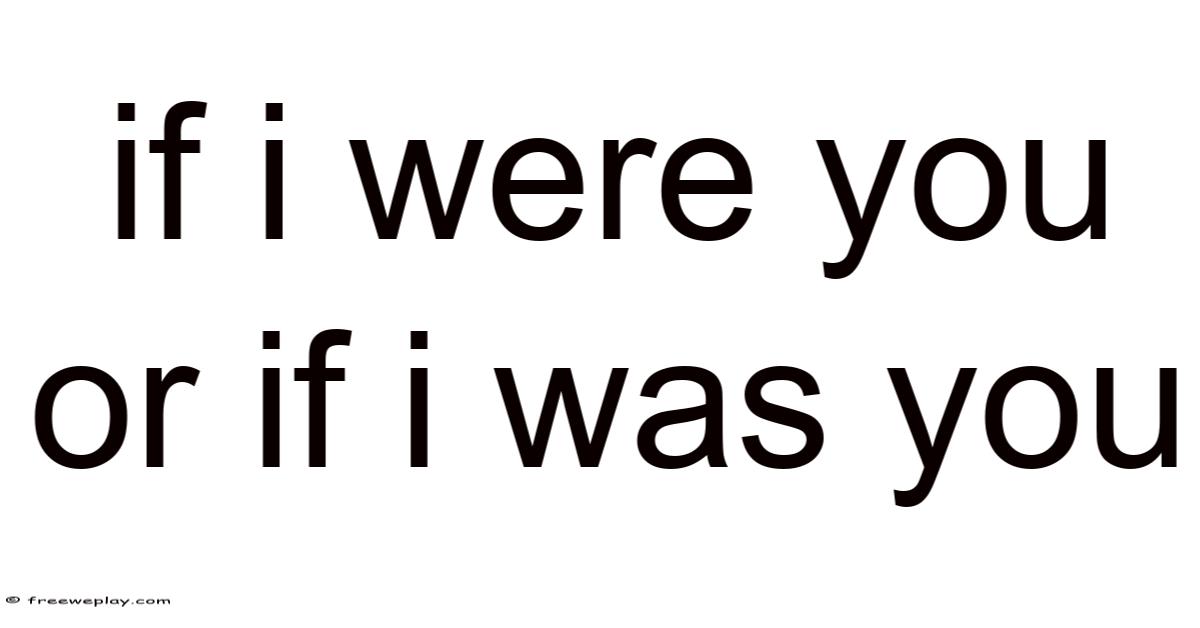
The phrases "if I were you" and "if I was you" are among the most commonly confused expressions in English, often sparking debates about grammar rules and usage. These seemingly simple sentences carry significant weight in how we communicate hypothetical situations, personal advice, and emotional responses. That's why understanding when to use each form is crucial for effective communication, whether in formal writing, professional settings, or everyday conversations. This article explores the nuanced differences between these two expressions, their historical context, and their practical applications in modern English.
Detailed Explanation
The Subjunctive Mood and Hypothetical Situations
The choice between "were" and "was" in the phrase "if I were you" hinges on the subjunctive mood, a grammatical feature that expresses hypothetical, imaginary, or uncertain situations. Here's the thing — in formal grammar, "were" is the correct choice for all subjects—I, you, he, she, it, we, they—when constructing third conditional sentences or expressing unreal conditions. Here's one way to look at it: "If I were you, I would take a different approach" clearly indicates a hypothetical scenario where the speaker is not actually in the listener’s position Which is the point..
In contrast, "was" is traditionally used in indicative mood statements that describe factual situations. Still, in modern English, especially in informal speech, "was" has increasingly replaced "were" in first and third person singular constructions. This shift reflects the natural evolution of language, where strict adherence to formal rules gives way to colloquial usage. Here's a good example: "If I was you, I’d reconsider" is widely accepted in casual contexts, even though it deviates from traditional grammar guidelines.
Modern Usage and Contextual Flexibility
The distinction between "were" and "was" becomes more complex when considering regional variations and social contexts. In British English, "were" remains the preferred form in formal writing, while American English shows greater flexibility, often accepting "was" in both formal and informal contexts. But this divergence highlights the dynamic nature of language, where practicality often trumps prescriptive rules. Understanding these nuances allows speakers to adapt their language choices based on audience expectations and the formality of the situation Simple, but easy to overlook..
Step-by-Step Concept Breakdown
Constructing Conditional Sentences
Creating sentences with "if I were you" or "if I was you" involves understanding the structure of conditional sentences. These sentences typically consist of two parts: the conditional clause (the "if" part) and the main clause (the result or consequence). In the case of "If I were you, I would...", the conditional clause uses the subjunctive "were", while the main clause employs a modal verb like "would" to express the hypothetical outcome No workaround needed..
For example:
- Conditional clause: If I were you (unreal condition)
- Main clause: I would accept the job offer (hypothetical result)
When using "was", the structure remains the same, but the tone shifts slightly toward informality or personal conviction. Consider:
- Conditional clause: If I was you (less formal, still hypothetical)
- Main clause: I’d definitely change my strategy (informal result)
Applying the Concepts in Practice
To master these constructions, it’s essential to recognize the intent behind the statement. Also, if the speaker is genuinely contemplating an alternative perspective, "were" is appropriate. On the flip side, if the speaker is emphasizing their personal belief or using a conversational tone, "was" might be more effective. Practicing these structures in various contexts helps solidify their proper usage and enhances overall communication clarity Most people skip this — try not to. Still holds up..
Real Examples
Professional and Personal Scenarios
In professional settings, "If I were you, I would consult a legal expert" conveys a formal recommendation, signaling respect for protocol and expertise. In real terms, conversely, "If I was you, I’d just go for it" might be used in a casual brainstorming session, reflecting a more relaxed approach to decision-making. These examples demonstrate how grammatical choices influence the perceived authority and tone of the message.
Personal relationships also benefit from this distinction. Day to day, a friend offering advice might say, "If I were you, I’d end that toxic friendship", emphasizing the seriousness of the suggestion. Meanwhile, a family member might use "If I was you, I’d take a vacation" to encourage self-care, blending sincerity with approachability Small thing, real impact..
Why the Choice Matters
The decision to use "were" or "was" affects how the audience interprets the speaker’s intent. "Were" suggests a measured, thoughtful recommendation, while "was" can imply confidence or urgency. This subtle difference is particularly important in negotiations, counseling, or mentorship, where the speaker’s tone and credibility are essential.
People argue about this. Here's where I land on it.
Scientific/Theoretical Perspective
Historical Evolution of the Subjunctive Mood
The subjunctive mood has undergone significant changes in English over the centuries. Historically, Old and Middle English relied heavily on subjunctive forms, but the modern subjunctive has become increasingly simplified. The retention of "were" in hypothetical constructions is a remnant
of a once-pervasive grammatical system. In Old English, distinct subjunctive inflections existed for nearly all verbs across both present and past tenses, used to mark everything from indirect speech to wishes and conditions contrary to fact. By Early Modern English, the past subjunctive had largely merged with the past indicative for all verbs except to be, leaving were as the sole surviving distinct form for the first and third person singular. As the language evolved through the Middle English period, these inflections eroded due to phonological leveling and the rise of modal auxiliaries (like should, would, could) to carry modal meaning. This makes the modern "If I were" a linguistic fossil—a preserved artifact of a richer morphological past that now serves a highly specialized syntactic function.
Cognitive Linguistics and Conceptual Distance
From the perspective of cognitive linguistics, the choice between were and was reflects the speaker’s conceptualization of epistemic distance. Here's the thing — the subjunctive were functions as a grammatical marker of "maximal hypotheticality," signaling that the scenario in the if-clause is not merely unlikely, but ontologically impossible in the current reality (e. That said, g. , "If I were you" implies I can never be you). This creates a clear mental space separation between the factual world and the counterfactual simulation That alone is useful..
Conversely, the indicative was reduces this conceptual distance. Practically speaking, cognitive grammarians argue this mirrors a shift in the speaker's stance: using was treats the hypothetical scenario as a plausible simulation—something that could feasibly map onto reality—rather than a pure logical impossibility. Because was is the standard form for factual past events ("I was late"), its use in a conditional blurs the line between reality and hypothesis. This explains why was thrives in contexts of empathy or role-playing ("If I was in your shoes, I'd feel the same"), where the speaker mentally simulates the other's position as a tangible, accessible experience rather than an abstract logical exercise.
Corpus Data and Contemporary Usage Trends
Large-scale corpus analyses, such as those from the Corpus of Contemporary American English (COCA) and the British National Corpus (BNC), confirm a definitive trajectory: was is steadily encroaching on were in conditional clauses across all registers, though the rate varies. In spoken American English, was now appears in counterfactual conditionals nearly 60–70% of the time. In edited academic and formal professional writing, however, were retains a stronghold above 85%, enforced by style guides and editorial tradition Simple as that..
Interestingly, the data reveals a lexical priming effect. Which means " comfortably, but "If the president were... On the flip side, " or "If the hypothesis were... " strongly prefers the subjunctive. A speaker might say "If I was...Because of that, high-frequency pronouns (I, he, she, it) favor was more readily than low-frequency nouns or complex noun phrases. Still, " or "If he was... This suggests the shift is not purely grammatical but processing-driven: speakers default to the high-frequency indicative form for common subjects unless the syntactic complexity or formality of the noun phrase triggers the "monitor" for the standard subjunctive form.
Common Pitfalls and How to Avoid Them
The "Wish" Trap
A frequent error involves extending the was substitution into volitional clauses following wish or as if/as though. Still, while "If I was you" is widely accepted in speech, "I wish I was taller" or "He acts as if he was the boss" remains stigmatized in standard written English far more heavily than the conditional usage. The volitional construction (wish + complement) demands the subjunctive were to mark the desire for a state that does not exist. Using was here often signals a lack of familiarity with formal register rather than a deliberate stylistic choice.
Correction Strategy: Mentally substitute were for was after wish, suppose, imagine, and as if. If the sentence describes a current unreality ("I wish I were there"), were is the standard. Reserve was experimentation for if-clauses only.
Hypercorrection and the "Were" Overreach
Conversely, anxiety about "getting it wrong" leads to hypercorrection: inserting were where the indicative is required. This occurs in open conditionals (real possibilities) and past-time counterfactuals requiring the past perfect It's one of those things that adds up..
- Incorrect: If the package were to arrive tomorrow, we will send it. (Future open conditional → use is/arrives)
- Incorrect: If I were knowing the answer yesterday, I would have told you. (Past counterfactual → use had known)
The subjunctive were is strictly for present/future counterfactuals (Second Conditional). It cannot replace the past perfect in Third Conditionals, nor the present indicative in First Conditionals Simple, but easy to overlook. But it adds up..
Agreement Errors with Compound Subjects
Writers often stumble when the subject of the if-clause is compound. Practically speaking, * Standard: *If he were here... * (Singular → were)
- Standard: *If they were here...
If he andshe were, the verb still takes the plural form were, confirming that the subjunctive does not change its shape according to number; the only requirement is that the clause remain in the past‑tense subjunctive regardless of how many subjects are conjoined. This observation extends to more elaborate compounds such as “If the teacher and the students were…,” where the verb must agree with the plural subject, not with any individual element That's the part that actually makes a difference..
Beyond compound subjects, writers sometimes overlook the interaction between the subjunctive and other verb forms in the main clause. In a genuine second‑conditional, the main clause pairs the if‑clause with a modal verb in the present or future (e.The correct pattern is If I were rich, I would travel the world or If I were rich, I could travel the world. On top of that, , would, could, might). In practice, g. Plus, mixing tenses can create a sense of temporal dissonance: If I were rich, I will travel the world sounds discordant because will belongs to the first conditional, not the second. Maintaining this temporal alignment helps the reader interpret the hypothetical relationship accurately.
Another subtle issue arises when the if‑clause contains a negation. The presence of not does not alter the subjunctive form, but it can affect pronunciation and processing. Speakers often contract were not to wasn't in informal speech, yet the subjunctive were remains the grammatical norm: If I weren’t able to attend, I would stay home. In formal writing, the uncontracted form is preferred, as the contraction may be misread as a simple past indicative.
The lexical priming effect described earlier also influences the choice between was and were in rapid production. Because high‑frequency pronouns are processed more quickly, the brain tends to retrieve the readily available indicative form, especially when the surrounding discourse is informal or when the speaker is under time pressure. In contrast, when the noun phrase is longer, less frequent, or carries a formal register, the mental monitor that enforces the subjunctive becomes more active, leading to a higher likelihood of were selection. Awareness of this bias can help writers deliberate their word choice rather than defaulting automatically.
Putting it simply, the subjunctive were is required in present‑time counterfactuals, after certain volitional verbs, and when the subject of the if‑clause is complex or formally marked. Speakers should be vigilant about maintaining correct agreement with compound subjects, preserving the present‑or‑future tense in the main clause, and avoiding contractions in formal contexts. By aligning production habits with these grammatical constraints, writers can reduce the frequency of stigmatized forms and convey precise hypothetical meanings.
Not obvious, but once you see it — you'll see it everywhere The details matter here..
At the end of the day, mastering the subjunctive were involves recognizing its limited distribution, respecting subject‑verb agreement in compound constructions, and staying attuned to the cognitive tendencies that bias speakers toward the more common was form. Applying these principles consistently will enhance both the accuracy and the stylistic appropriateness of conditional statements in written and spoken English Small thing, real impact..
