Introduction
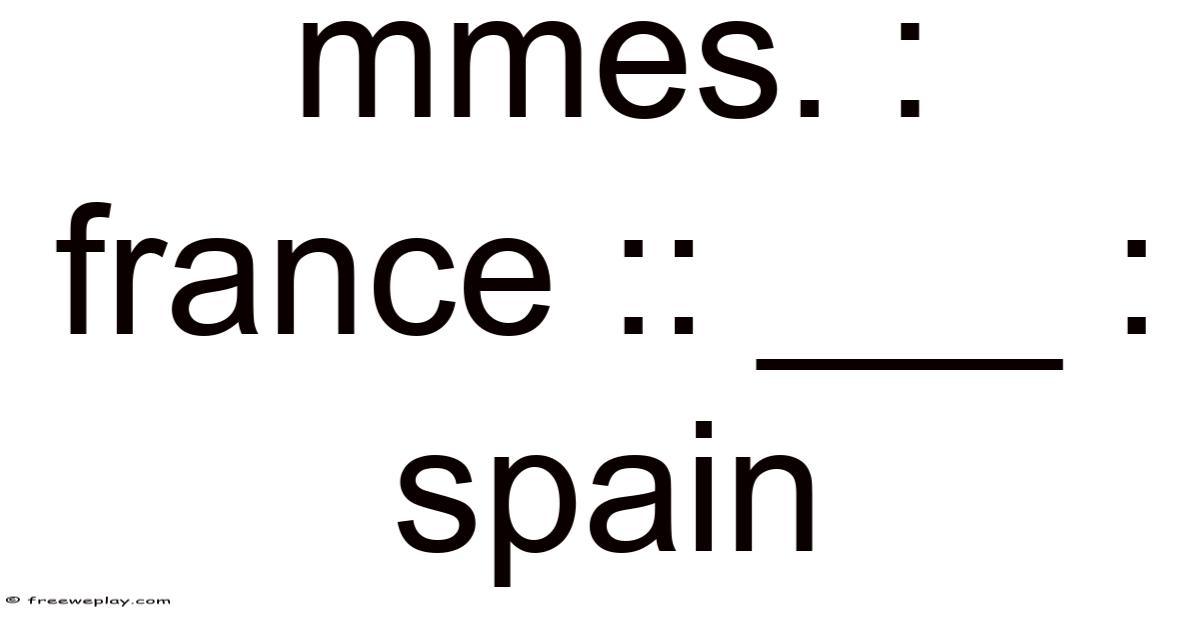
When you encounter a cryptic expression such as “mmes. : france :: ___ : spain”, the mind immediately looks for a pair of equivalent institutions, acronyms or official titles that link the two countries. Now, in the French administrative landscape, MMES stands for Ministère des Métiers, de l'Enseignement supérieur et de la Recherche (the Ministry of Vocational Training, Higher Education and Research). The colon‑style analogy (“A : B :: C : D”) asks us to fill the blank with the Spanish counterpart that performs the same set of functions as the French MMES.
In this article we will explore the French MMES, identify its Spanish analogue, and examine why understanding this equivalence matters for students, policymakers and professionals who move between the two nations. By the end of the reading you will not only know the exact Spanish institution that completes the analogy, but also grasp the historical, legal and practical background that underpins the relationship between French and Spanish higher‑education ministries Worth knowing..
Detailed Explanation
What is the French MMES?
The Ministère des Métiers, de l'Enseignement supérieur et de la Recherche (MMES) is a central state body in the French Republic. Created in 2006 under the name Ministère de l'Enseignement supérieur et de la Recherche and later enriched with the “Métiers” (vocational training) portfolio, the ministry is responsible for:
- Higher‑education policy – setting the strategic direction for universities, grandes écoles, and other tertiary institutions.
- Research funding – allocating budgets to national research agencies (CNRS, INSERM, etc.) and overseeing the French participation in European research programmes such as Horizon Europe.
- Vocational training – coordinating apprenticeship schemes, professional schools and the alignment of curricula with labour‑market needs.
The MMES works closely with other ministries (Education Nationale, Travail, Économie) and with regional authorities to make sure French higher education remains internationally competitive while staying responsive to domestic economic priorities.
The Spanish Counterpart
In Spain, the institution that mirrors the French MMES is the Ministerio de Universidades (Ministry of Universities). Since the 2018 government re‑organisation, Spain split its former Ministerio de Educación, Cultura y Deporte into two separate bodies:
- Ministerio de Educación y Formación Profesional – covering primary, secondary and vocational training.
- Ministerio de Universidades – dedicated exclusively to university policy, research funding, and the coordination of the Spanish higher‑education system.
Thus, the blank in the analogy “mmes. : france :: ___ : spain” is best filled with “Ministerio de Universidades”. Both ministries share the core mission of steering university education, fostering scientific research, and linking academic programmes with the needs of the labour market Took long enough..
Why the Analogy Works
The analogy follows a classic A : B :: C : D pattern, meaning “A is to B as C is to D”. Here:
- A = “mmes.” – the French abbreviation for the ministry that governs higher education and research.
- B = “france” – the country in which that ministry operates.
- C = “Ministerio de Universidades” – the Spanish ministry with the same functional scope.
- D = “spain” – the country where this ministry functions.
Both ministries are central state organs, both are legally mandated to design national strategies for tertiary education, and both manage public research funds. The parallelism is therefore exact, making the analogy a useful mnemonic for students of comparative public administration Took long enough..
Step‑by‑Step Breakdown of the Analogy
- Identify the abbreviation – Recognise that “mmes.” is not a random string but an acronym for a French ministry.
- Determine the functional domain – Examine the responsibilities attached to the French MMES (higher education, research, vocational training).
- Search for the Spanish entity with the same remit – Look at the current Spanish governmental structure; the Ministerio de Universidades matches the French scope.
- Validate the equivalence – Cross‑check legal texts (French Code de l’Éducation, Spanish Ley de Universidades) to confirm overlapping competencies.
- Complete the analogy – Insert the Spanish name into the blank, yielding “Ministerio de Universidades”.
Following these steps ensures that the analogy is not merely linguistic but also substantive.
Real Examples
Student Mobility
A French engineering student wishes to spend a semester at a Spanish university. Now, the MMES and the Ministerio de Universidades jointly oversee the Erasmus+ programme, guaranteeing credit transfer, tuition waivers and scholarship funding. Understanding that both ministries share responsibility for international agreements helps the student manage the administrative portal of either country without confusion That's the part that actually makes a difference..
It sounds simple, but the gap is usually here Not complicated — just consistent..
Joint Research Projects
Consider a collaborative climate‑change study involving CNRS (France) and CSIC (Spain). Researchers must submit parallel proposals, respecting the evaluation criteria of both ministries. Funding calls are issued simultaneously by the French MMES (through the Programme d’Investissements d’Avenir) and by the Spanish Ministerio de Universidades (through the Programa Estatal de Investigación). Knowing the exact counterpart avoids misdirected applications and streamlines cross‑border cooperation.
Policy Transfer
When Spain introduced the “Bolsa de Investigación” (research grant) scheme in 2020, French policymakers consulted the MMES’s earlier “Programme d’Excellence” to adapt best practices. Conversely, the MMES has studied Spain’s “Universities of Excellence” ranking methodology to refine its own accreditation processes. The two ministries thus act as policy laboratories for each other.
Scientific or Theoretical Perspective
From a comparative institutional theory standpoint, the MMES and the Ministerio de Universidades exemplify functional isomorphism: distinct political systems develop analogous structures when faced with similar policy problems (e.g., the need to coordinate university governance, research funding, and labour‑market alignment).
Key theoretical concepts include:
- Neo‑institutionalism – suggests that ministries adopt similar forms because they are subjected to common external pressures (EU regulations, global university rankings).
- Policy diffusion – explains how successful reforms in one country (e.g., France’s “Licence‑Master‑Doctorat” alignment with the Bologna Process) are replicated in another, facilitated by the ministries’ direct communication channels.
- Governance networks – both ministries operate within multi‑level networks that involve regional governments, university councils, and private research organisations. Understanding these networks clarifies why the two bodies, despite national differences, converge on many administrative practices.
These theories help scholars predict future convergence (e.In practice, g. , joint European research funding bodies) and explain the persistence of the analogy in academic discourse Most people skip this — try not to. That alone is useful..
Common Mistakes or Misunderstandings
-
Confusing the Ministry of Education with the MMES – In France, the Ministère de l’Éducation nationale handles primary and secondary schooling, not higher education. Likewise, Spain’s Ministerio de Educación y Formación Profesional is distinct from the Ministerio de Universidades. Mixing them leads to erroneous references to policy scopes.
-
Assuming “MMES” is a permanent name – The French ministry has undergone several renamings (e.g., Ministère de l’Enseignement supérieur et de la Recherche). Using an outdated acronym can cause miscommunication, especially in official documents.
-
Overlooking the vocational‑training component – The French MMES explicitly includes “Métiers”, linking universities with apprenticeships. Spain’s vocational training is housed in a separate ministry, so direct equivalence exists only for the university and research parts That's the part that actually makes a difference..
-
Neglecting regional autonomy – Both France and Spain have decentralized elements (French regions, Spanish autonomous communities) that influence university governance. Assuming the ministries have absolute control ignores the negotiated power‑sharing arrangements that shape policy implementation That alone is useful..
By keeping these nuances in mind, students and professionals can avoid common pitfalls when working across the two systems.
Frequently Asked Questions
1. What does the abbreviation “MMES” stand for in French?
Answer: It stands for Ministère des Métiers, de l'Enseignement supérieur et de la Recherche. The ministry oversees university policy, national research funding, and the alignment of higher‑education programmes with labour‑market needs Still holds up..
2. Which Spanish ministry is equivalent to France’s MMES?
Answer: The Ministerio de Universidades. It is the central body responsible for university governance, research funding, and coordination of the Spanish higher‑education system.
3. Does the Spanish Ministerio de Universidades also manage vocational training?
Answer: No. Vocational training in Spain falls under the Ministerio de Educación y Formación Profesional. The Spanish ministry that mirrors the French MMES focuses solely on universities and research It's one of those things that adds up..
4. How do the two ministries cooperate at the European level?
Answer: Both ministries are active participants in EU programmes such as Erasmus+, Horizon Europe, and the European Research Area. They co‑author joint calls for proposals, exchange best practices through the European University Association, and coordinate national implementation of EU directives on higher education.
5. Are there any recent reforms that have changed the scope of these ministries?
Answer: Yes. In France, the 2021 Loi sur la refondation du système universitaire expanded the MMES’s role in digital transformation. In Spain, the 2023 Ley de Universidades introduced new performance‑based funding criteria, reinforcing the Ministerio de Universidades’ authority over research evaluation.
Conclusion
The cryptic analogy “mmes. : france :: ___ : spain” is solved by recognizing that MMES denotes the French Ministry of Vocational Training, Higher Education and Research, and that its Spanish counterpart is the Ministerio de Universidades. Both institutions sit at the heart of their respective national higher‑education systems, steering university policy, allocating research funds, and linking academia with the labour market Not complicated — just consistent..
Understanding this equivalence is more than an academic exercise; it equips students, scholars, and policymakers with the vocabulary and institutional awareness needed to work through bilateral programmes, secure funding, and contribute to the ongoing convergence of European higher‑education governance. By appreciating the historical evolution, theoretical underpinnings and practical implications of these ministries, you become better prepared to engage with the transnational academic landscape that defines contemporary Europe.
