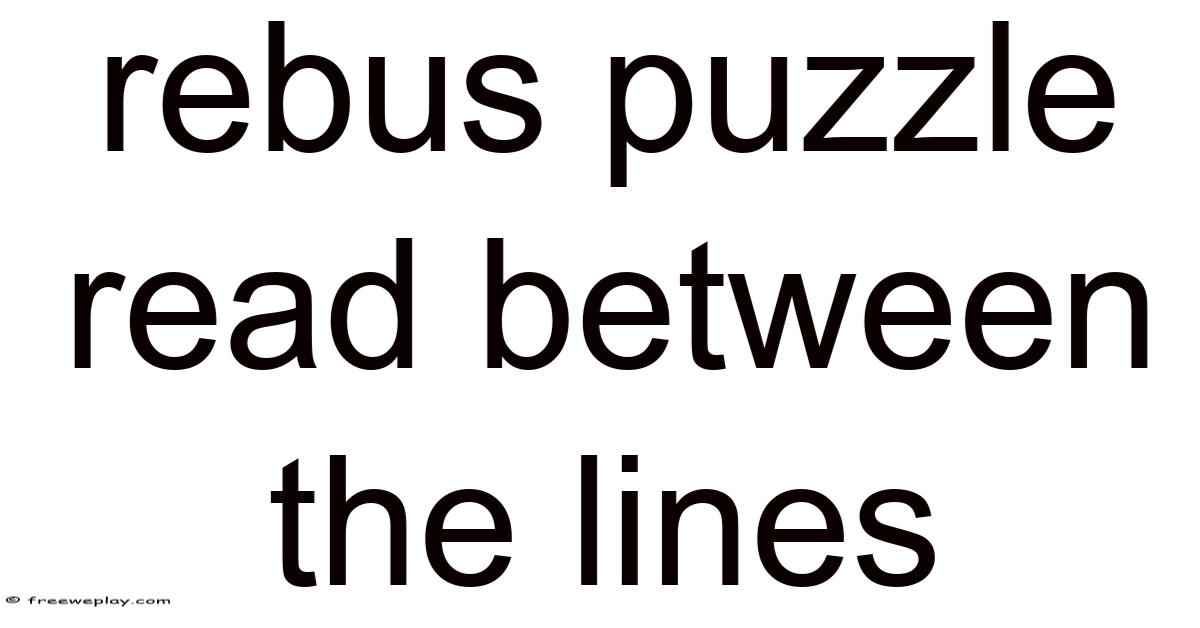
Rebus Puzzle: Read Between the Lines – The Ultimate Guide to Decoding Hidden Meanings
Introduction
Have you ever stared at a seemingly random collection of images, letters, and numbers, only to feel a sudden spark of recognition when the hidden phrase clicks into place? So that is the magic of a rebus puzzle, a clever brain teaser that challenges you to decode words and phrases by interpreting visual clues, symbols, and spatial relationships. Among the most intriguing variations of these puzzles is the concept of "read between the lines," where the solution depends not on what you see directly, but on what is implied, positioned, or hidden. This article provides a comprehensive exploration of rebus puzzles that require you to read between the lines, offering a detailed explanation of their structure, step-by-step decoding strategies, real-world examples, the cognitive science behind them, and common pitfalls to avoid. By the end, you will not only understand how these puzzles work but also gain the confidence to solve them quickly and creatively Practical, not theoretical..
Short version: it depends. Long version — keep reading.
Detailed Explanation
What Is a Rebus Puzzle?
A rebus puzzle is a visual word puzzle that uses pictures, letters, numbers, symbols, and their relative positions to represent a word or phrase. The name comes from the Latin phrase “non verbis, sed rebus,” which means "not by words, but by things." In essence, a rebus conveys meaning through objects and arrangements rather than straightforward written language. To give you an idea, the image of a bee followed by the letter "U" represents the word "beauty" (bee + U + ty, with "ty" implied by the sound). These puzzles have been around for centuries, appearing in ancient Egyptian hieroglyphics, medieval heraldry, and modern-day puzzle books and mobile apps.
The "Read Between the Lines" Variation
The phrase "read between the lines" is itself an idiom meaning to understand a hidden or implied meaning. Worth adding: in the context of rebus puzzles, this variation requires solvers to look beyond the literal images and consider the spaces, gaps, positions, absences, and arrangements of elements. In real terms, for instance, a puzzle might place the word "love" above the word "you," with a line drawn between them. The solution could be "love in between you" or "love between you." Another common example is a puzzle where the word "stand" is written, and directly beneath it, the letter "I" is placed. The answer is "understand" because you must read the letter "I" under the word "stand." This type of puzzle forces you to interpret not just the symbols themselves but also their spatial relationships, directions, and implied connections And it works..
Why Is "Reading Between the Lines" Significant?
The ability to solve these puzzles relies heavily on lateral thinking and cognitive flexibility. Practically speaking, unlike straightforward riddles, rebus puzzles that require reading between lines demand that you shift your perspective: you cannot take everything at face value. This skill is valuable beyond puzzles—it enhances your capacity to interpret ambiguous communication, recognize subtext in conversations, and approach problems from unconventional angles. In educational settings, these puzzles are used to develop visual literacy, pattern recognition, and creative problem-solving That alone is useful..
Step-by-Step or Concept Breakdown
Step 1: Identify the Elements
The first step in solving any rebus puzzle is to list all the visible components. These may include:
- Single letters (e.In real terms, g. On top of that, , "A," "B," "I")
- Words (e. g.That's why , "love," "stand," "world")
- Numbers (e. g., "2," "4")
- Images (e.Which means g. , a bee, an eye, a heart)
- Symbols (e.g.
Write down each element separately. Do not assume their roles yet. To give you an idea, if you see the word "BEST" inside a small box, you note both the word and the box That's the whole idea..
Step 2: Analyze Spatial Relationships
Now look at how these elements are arranged relative to one another. On the flip side, ask yourself:
- Is one element above another? - Is an element to the left, right, or directly below another?
- Are elements placed inside something else (like inside a box, circle, or letter)?
- Is there a line, arrow, or gap separating them?
For a "read between the lines" puzzle, pay special attention to empty spaces, gaps, and lines drawn between elements. Which means these are often the key to the hidden meaning. Take this case: if the word "READ" is written, and below it there is a long horizontal line, and below that the word "LINES" appears, the solution is likely "read between the lines" itself Simple as that..
Step 3: Consider Direction and Position
Sometimes the puzzle uses directional cues. " For example:
- The letter "A" placed inside the letter "O" = "a in o" = "ain't" (a homophone) or simply "in." The position of letters relative to each other can indicate prepositions like "in," "on," "under," "above," "between," or "around."
- The word "TIME" written on top of the word "LINE" = "time on line" or "time online.An arrow pointing upward might mean "up" or "rise." A word written upside down might mean "opposite" or "reverse."
- The word "FOOT" next to the word "MOUTH" = "foot in mouth.
Step 4: Use Homophones and Phonetics
Rebus puzzles frequently rely on homophones—words that sound the same but have different meanings or spellings. A picture of a "bee" stands for the sound "be," an "eye" stands for "I," a "heart" stands for "love," and a "knot" stands for "not.Which means " When reading between lines, you may also need to drop letters or add sounds based on position. To give you an idea, if you see the word "MINUTE" with a line through it, it might mean "minute" is struck out, so you "cross out minute," implying "no minute" or "immediately"?
Step 5: Combine and Verify
After interpreting each component and its spatial relationship, combine them into a phrase. Day to day, if you get a result like "love between you," that is a plausible answer for a puzzle where the word "LOVE" is above "YOU" with a line separating them. On the flip side, does it sound like a common idiom, a movie title, a famous saying, or a well-known word? That said, read it aloud. If the result is gibberish, revisit your spatial analysis—perhaps the line is not a separator but a connector, or the gap is meant to be read as "space Simple, but easy to overlook. Simple as that..
Not obvious, but once you see it — you'll see it everywhere.
Real Examples
Example 1: The Classic "Understand" Puzzle
- Visual: The word "STAND" written normally. Directly beneath it, the letter "I" is centered.
- Interpretation: You have the word "stand" and the letter "I" is under it. So you read "I under stand" which sounds like "understand."
- Why it works: This puzzle perfectly illustrates reading between lines because you must perceive the spatial relationship (under) and then translate that into a preposition that creates a real word.
Example 2: "Read Between the Lines" Itself
- Visual: The word "READ" is written at the top. A horizontal line is drawn beneath it. Below that line is the word "LINES."
- Interpretation: The line separates "READ" and "LINES." Your instruction is to read the word that appears between the lines? Actually, you read "read," then identify the line, then read "lines." The phrase becomes "read between the lines."
- Why it matters: This is a meta-puzzle that teaches the very concept of the puzzle type. It reinforces that the answer is often a familiar idiom.
Example 3: "I Love You" with a Heart
- Visual: The letter "I," then a red heart, then the letter "U."
- Interpretation: "I" (eye sound), heart (love symbol), "U" (letter sounding like "you"). Combined: "I love you."
- Variation with lines: Suppose the heart is drawn between two horizontal lines, and the "I" is above the top line, and "U" is below the bottom line. The solution could be "I love you from above and below" or more simply "I love you in between." In some puzzles, the heart inside a line box might mean "love in captivity" which is not common, so you must use common sense.
Example 4: "Time After Time"
- Visual: The word "TIME" appears repeatedly, each instance stacked vertically, with a small arrow pointing upward or downward.
- Interpretation: If "TIME" is stacked with an upward arrow, you might read "time after time" (if the arrow suggests "after" as in following). If the arrow points to the gap between the two "TIME" words, you could read "time between times." The exact solution depends on the puzzle's specific design, but the principle remains: you must read the arrangement, not just the words.
Scientific or Theoretical Perspective
Cognitive Psychology and Pattern Recognition
Solving rebus puzzles, especially those that require reading between lines, engages several high-level cognitive processes. Because of that, Pattern recognition is the primary mechanism: your brain constantly searches for familiar shapes, sequences, and relationships. When you see a line between two words, your visual cortex processes the line as a boundary, and your language centers then attempt to map that boundary onto a linguistic concept (like "between").
This is where a lot of people lose the thread.
The Role of Gestalt Principles
Gestalt psychology explains that humans naturally perceive whole patterns rather than isolated parts. In a rebus, the mind seeks closure—it tries to complete the missing pieces. The law of proximity dictates that elements placed close together are perceived as a group. The law of similarity suggests that similar objects (e.And g. That said, , all letters) are grouped. Day to day, the law of continuation implies that lines and gaps guide the eye. When you read between the lines, you are leveraging the figure-ground principle: the line becomes the "figure" that separates two "ground" areas, and the hidden meaning emerges from that separation.
Neural Pathways and Lateral Thinking
Studies on puzzle-solving show that rebus puzzles activate the prefrontal cortex, responsible for reasoning and problem-solving, as well as the temporal lobes, which handle language and memory. This is a form of divergent thinking, where multiple solutions are considered simultaneously. The demand to "read between the lines" forces the brain to inhibit the obvious interpretation (literal reading) and activate alternative meanings. Over time, regular engagement with such puzzles can strengthen neural connections related to flexibility and creativity Worth knowing..
Common Mistakes or Misunderstandings
Mistake 1: Ignoring the Lines and Gaps
Many beginners focus solely on the words or pictures and overlook the lines, arrows, or empty spaces. And for example, a puzzle showing the word "BET" above the word "US" with a horizontal line between them is not "bet us"—it is "bet between us. Worth adding: " The line is not decorative; it is a key element. Always treat lines, borders, and gaps as significant clues.
Real talk — this step gets skipped all the time.
Mistake 2: Assuming a Literal Reading
Another common error is to read the elements in a left-to-right, top-to-bottom sequence as if they were normal text. The word "BROWN" written upside down next to a picture of a cow does not mean "brown cow"; it might mean "cow with brown upside down" leading to "cow down brown" or something like "brown cow down" or more likely "cow brown turned" which is silly. Rebus puzzles often break this rule. Instead, recognize that orientation, inversion, and position are part of the code.
Mistake 3: Overcomplicating the Solution
Some solvers try to construct elaborate phrases when the answer is a simple, common expression. If your solution sounds unnatural or obscure, it is probably wrong. The most common rebus answers are idioms, compound words, or well-known sayings. Still, for example, a puzzle with the word "EVERY" above the word "NOW" and a line between them might be "every now and then" if you also see the word "AND" to the side? Actually, if only "EVERY" and "NOW" appear with a line, the answer is "every now and then"—because you read "every" then "now" then the line (meaning "and") then nothing? Consider this: this is tricky. The point is: the solution must be something a native speaker would recognize instantly.
Mistake 4: Misinterpreting Prepositions
Prepositions like "in," "on," "under," "over," "between," "above," "below," "around," "through" are often signaled by spatial arrangements. On the flip side, a letter placed inside another means "in. " A letter placed on top of another means "on." A line between two words means "between." Confusing "on" with "in" can completely change the answer. Practice by creating a mental dictionary of spatial cues The details matter here..
FAQs
1. What is the difference between a regular rebus puzzle and one that requires reading between the lines?
A regular rebus puzzle typically relies on homophones, images, and simple combinations of letters and symbols (for example, a picture of a "bee" plus a picture of a "leaf" equals "belief"). Here's the thing — a puzzle that requires reading between the lines adds an extra layer: you must interpret spatial relationships, gaps, lines, or directions as part of the message. The phrase "read between the lines" itself becomes a puzzle mechanic, meaning the answer is often about what is implied by the arrangement rather than the elements alone Most people skip this — try not to..
2. How can I improve my ability to solve "read between the lines" rebus puzzles?
Practice and exposure are key. Also, familiarize yourself with common idioms and compound words, as these are frequent solutions. Start by solving simple rebus puzzles that use spatial cues (like the "understand" example). That said, build a mental vocabulary of common spatial prepositions: in, on, under, above, between, around, through, over, beside. Finally, when you encounter a puzzle, deliberately list all spatial features (lines, gaps, positions) before trying to interpret the words or pictures.
3. Are these puzzles useful for language learning?
Yes, they are excellent for language learners. Rebus puzzles force learners to think about homophones, prepositions, and idiomatic expressions in a visual context. As an example, a learner of English might see "I" (eye) + "heart" (love) + "U" (you) and immediately grasp the phrase "I love you" without direct translation. The spatial puzzles further reinforce prepositions that are often difficult to master, such as "between," "under," and "above.
4. Why do some people find "read between the lines" puzzles more difficult than other puzzles?
These puzzles are more challenging because they require simultaneous processing of visual and linguistic information while
These puzzles are more challenging because they require simultaneous processing of visual and linguistic information while demanding the solver to maintain a mental map of spatial relations and linguistic cues at the same time. This dual load stretches working memory and forces the brain to switch rapidly between perception and language decoding, which is why even seasoned puzzlers may stumble Worth keeping that in mind..
Final thoughts
Rebus puzzles that ask you to “read between the lines” are essentially a workout for the brain’s ability to blend sight and speech. The key to mastering them lies in three simple habits:
- Spot the geometry – Identify every line, gap, overlap, or placement before assigning meaning. A single underline can turn “over” into “under,” and that tiny shift often unlocks the whole clue.
- Build a spatial lexicon – Keep a mental list of the most common prepositions and the effects they produce (e.g., “in” → containment, “on” → surface contact, “between” → separation).
- Practice the pause – Before jumping to a homophone or a picture‑based answer, take a moment to catalogue the arrangement. That brief pause creates the mental space needed to see the hidden connection.
When these habits become routine, the “aha!” moment arrives almost automatically. The once‑cryptic layout transforms into a clear, instantly recognizable phrase, and the satisfaction of solving the puzzle fuels further curiosity and learning.
In short, the path to conquering “read between the lines” rebus puzzles is paved with attentive observation, a well‑stocked mental dictionary of spatial cues, and disciplined practice. With those tools in hand, every puzzle becomes a rewarding exercise in linguistic insight rather than a baffling mystery.
It sounds simple, but the gap is usually here.
