Introduction
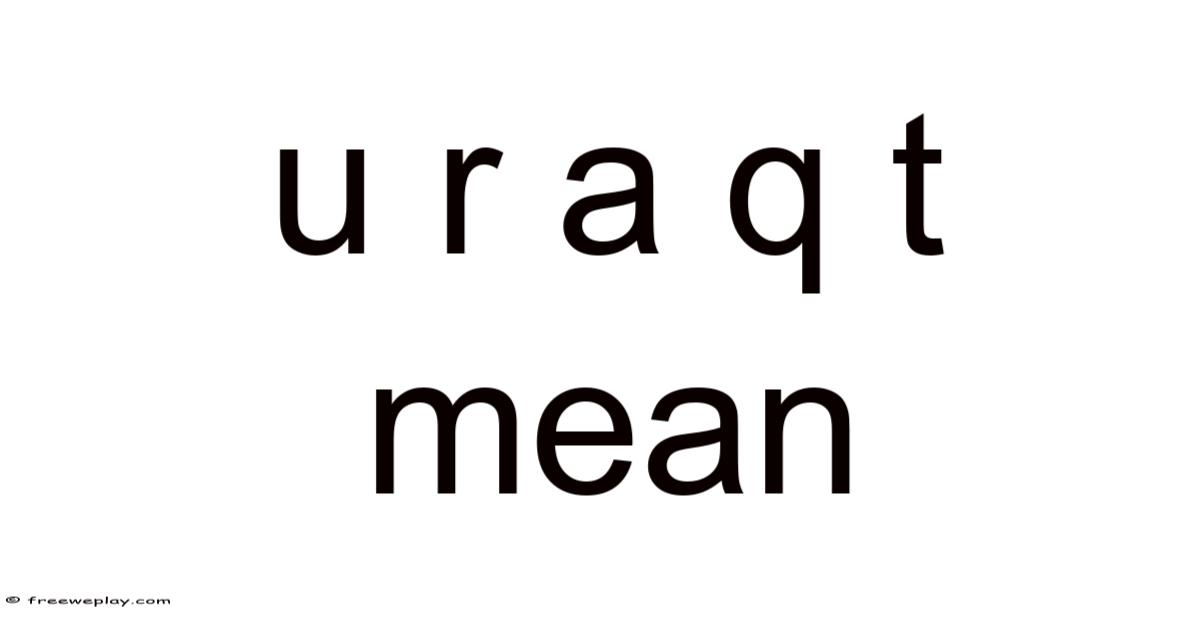
In the fast-paced, digital-first era of modern communication, the way we interact has shifted from long-form letters to rapid-fire text messages and social media comments. So naturally, a new dialect of "internet slang" has emerged, characterized by abbreviations, phonetic spellings, and creative acronyms. One of the most common and endearing phrases you will encounter in a DM (Direct Message) or a comment section is **"u r a q t.
If you have ever received this message and felt a sudden surge of confusion, you are not alone. That said, at its core, "u r a q t" is a phonetic way of writing the phrase "You are a cutie. " It is a playful, lighthearted, and highly informal way to compliment someone's appearance or personality. This article will dive deep into the origins, usage, and social nuances of this digital shorthand to ensure you never misinterpret it again Practical, not theoretical..
Detailed Explanation
To understand "u r a q t," one must first understand the concept of phonetic texting. Worth adding: in the early days of SMS (Short Message Service) and T9 predictive text, character limits were strict and typing on a numeric keypad was cumbersome. To save time and space, users began replacing entire words with single letters or numbers that sounded similar. As an example, "you" became "u," and "are" became "r That's the part that actually makes a difference. No workaround needed..
When we apply this logic to the word "cutie," the transformation becomes a clever linguistic puzzle. That's why the letter "q" is pronounced "cue," and the letter "t" is pronounced "tee. " When placed together, "q t" sounds exactly like "cutie." Which means, "u r a q t" translates literally to "You are a cute T," which the brain immediately processes as "You are a cutie.
This type of slang is rarely used in professional or formal settings. It is strictly reserved for casual, intimate, or flirtatious interactions. It serves as a "low-stakes" compliment; because it is written in a playful, almost childish way, it reduces the intensity of a direct compliment, making it feel more whimsical and less intimidating for both the sender and the receiver Still holds up..
Concept Breakdown: How the Slang Works
To master the art of reading internet slang, it is helpful to break down the phonetic components of the phrase. And that's what lets you decode similar abbreviations that might appear in the future Easy to understand, harder to ignore..
- The Subject ("u"): This is the standard digital replacement for "you." It is the most foundational element of modern texting shorthand.
- The Verb ("r"): This replaces "are." In the logic of text-speak, the letter itself carries the phonetic weight of the word, making it an efficient way to maintain grammatical structure without the extra keystrokes.
- The Adjective/Noun ("a q t"): This is the most creative part of the phrase. Instead of spelling out the word "cutie," the sender uses the letters Q and T to mimic the syllables of the word.
By breaking it down this way, you can see that the phrase follows a strict phonetic logic. It is not a random string of letters, but a highly efficient way of conveying emotion through sound rather than traditional spelling Simple, but easy to overlook..
Real Examples
In real-world scenarios, "u r a q t" can appear in various social contexts, each carrying a slightly different "vibe."
- Flirtatious Context: A common scenario occurs in the early stages of dating or "talking." If someone sends you a photo of yourself smiling or wearing a new outfit, a response like "u r a q t" is a way of expressing attraction without being overly heavy or serious. It acts as a "tester" to see if the recipient is open to flirting.
- Platonic/Friendly Context: Sometimes, friends use this phrase to react to something adorable. If a friend posts a video of their new puppy or a funny, endearing photo of themselves, a comment saying "u r a q t" can be a way of saying "you are adorable" in a friendly, non-romantic way.
- Social Media Comments: On platforms like Instagram or TikTok, you might see this in the comments of a creator's post. It is a quick way for fans to show affection and appreciation for the person's persona or aesthetic.
In all these examples, the phrase serves as a social lubricant. It eases the tension of giving a compliment by wrapping it in a layer of digital playfulness Simple, but easy to overlook..
Scientific or Theoretical Perspective
From a linguistic standpoint, "u r a q t" is an example of orthographic improvisation. This occurs when users deviate from standard spelling rules to achieve a specific communicative goal—in this case, speed and tone.
Linguists often study how digital communication creates "subcultures." The use of "q t" instead of "cutie" creates an "in-group" feeling. If you understand the slang, you are part of the digital culture; if you don't, you are an outsider. And this is a form of social signaling. By using such a condensed form, the sender is signaling that the conversation is informal, relaxed, and safe from the rigid rules of formal grammar And that's really what it comes down to..
On top of that, the use of phonetic abbreviations can be linked to Cognitive Processing Theory. Even though the spelling is "incorrect," the human brain is incredibly efficient at "autocorrecting" these strings of letters into meaningful words based on phonetic patterns. We don't "read" the letters; we "hear" them in our heads, which is why "q t" works so effectively Not complicated — just consistent..
Common Mistakes or Misunderstandings
Despite its simplicity, there are a few ways this phrase can be misinterpreted:
- Misinterpreting the Tone: Because "u r a q t" is so informal, using it in a professional setting (like an email to a supervisor) would be a major social faux pas. It could be perceived as unprofessional or even inappropriately flirtatious.
- Assuming Romantic Intent: A common mistake is assuming that because someone said "u r a q t," they are definitely interested in a romantic relationship. While it is often used in flirting, it can also be used platonically. It is important to read the broader context of the conversation before jumping to conclusions.
- Overuse: Using too much slang can sometimes make a person's communication seem immature or difficult to understand. While "u r a q t" is a cute phrase, relying too heavily on phonetic abbreviations can lead to "texting fatigue" where the meaning of the message gets lost in the shorthand.
FAQs
1. Is "u r a q t" grammatically correct?
No, it is not grammatically correct by standard English rules. It is a form of informal internet slang designed for speed and phonetic playfulness. It should never be used in formal writing, academic papers, or professional emails.
2. Is "u r a q t" offensive?
Generally, no. It is intended as a compliment. Even so, like any compliment, its appropriateness depends on your relationship with the person. If you say it to a stranger, it might be seen as overly forward or "cringe," but in a friendly or romantic context, it is usually well-received.
3. What is the difference between "u r a q t" and "you are cute"?
The difference lies in the tone and intent. "You are cute" is a direct, standard English compliment. "u r a q t" is more playful, casual, and "text-friendly." The slang version feels lighter and less "heavy" than the standard version.
4. How do I respond to "u r a q t"?
Your response should depend on how you feel! If you like the person, a playful emoji (like 😊 or 😉) or a similar slang response works well. If you want to keep it friendly, a simple "thank you!" is perfectly sufficient.
Conclusion
In a nutshell, "u r a q t" is a fascinating example of how language evolves to meet the needs of digital communication. By transforming the phrase "you are a cutie" into a series of phonetic letters, users have created a shorthand that is efficient, playful, and highly expressive.
Short version: it depends. Long version — keep reading.
Understanding this term is about more than just knowing a definition; it is about understanding the social nuances of modern interaction. Whether it is being used as a subtle
Whether it is being used as a subtle flirtation, a friendly tease, or simply a quick way to brighten someone's day, the phrase illustrates how internet culture reshapes language for brevity and emotional nuance. On top of that, ultimately, embracing such slang enriches our digital lexicon while reminding us to stay mindful of context and audience. Recognizing its informal nature helps us work through when it’s appropriate and when a more formal expression is warranted. In the ever‑changing landscape of online communication, “u r a q t” serves as a playful reminder that even the shortest messages can carry warmth, humor, and a touch of personality—provided we use them with the right intention and awareness Easy to understand, harder to ignore..
