Introduction
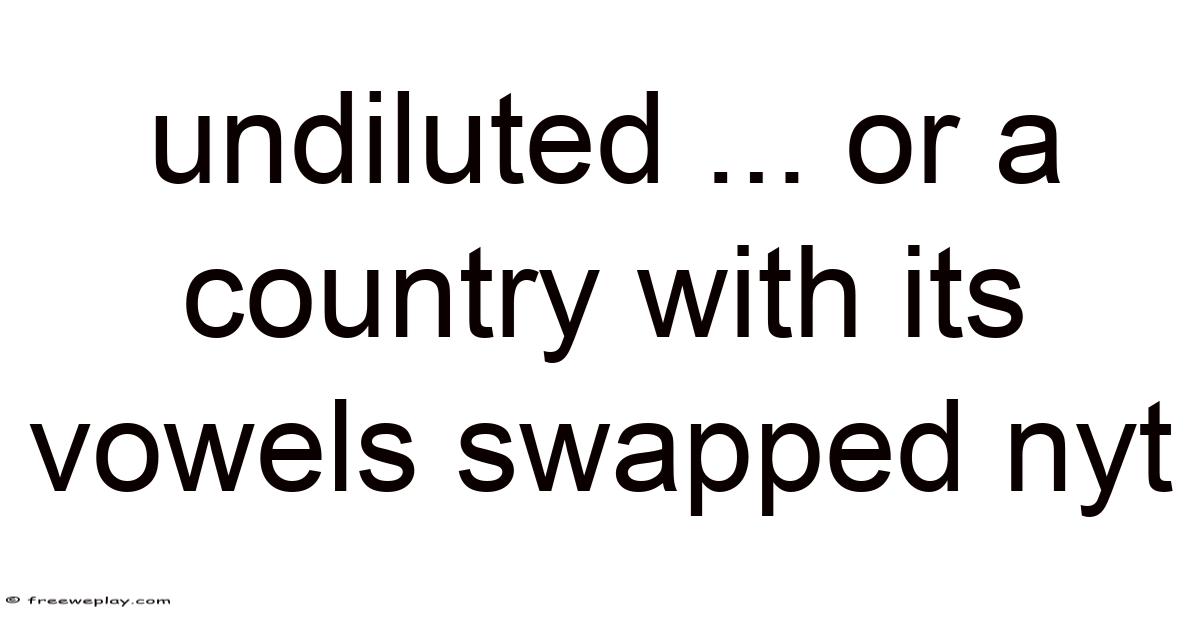
The phrase "undiluted ... or a country with its vowels swapped nyt" is a clever example of a wordplay puzzle commonly found in the New York Times crossword puzzles and other brain-teasing games. Which means at first glance, it appears to be two separate clues connected by the word "or," but upon closer inspection, it reveals a hidden connection between the words "undiluted" and a country's name. This type of riddle challenges solvers to think creatively about language, phonetics, and geography. By swapping the vowels in a country’s name, the puzzle hints at another word or phrase, in this case, "undiluted." Understanding how such puzzles work requires a deep dive into the mechanics of vowel substitution, linguistic patterns, and the art of cryptic crossword clues. This article will explore the structure of this puzzle, explain its solution, and get into the broader world of wordplay puzzles that have captivated minds for centuries.
Detailed Explanation
The phrase "undiluted ... or a country with its vowels swapped nyt" is a cryptic crossword clue, a format popularized by the New York Times and other puzzle creators. Cryptic clues often contain two parts: a definition and a wordplay component. In this case, "undiluted" serves as the definition, while "a country with its vowels swapped" provides the wordplay instructions. To solve it, one must identify a country whose vowels, when rearranged or substituted, form the word "undiluted."
The key to solving this puzzle lies in understanding vowel substitution. Now, vowels in the English language are A, E, I, O, U, and sometimes Y. Swapping or replacing these letters in a country’s name can produce unexpected results. Because of that, this transformation is the crux of the puzzle: the country Ireland becomes UAE when its vowels are swapped. If these vowels are replaced with other vowels (such as U, A, and E), the result is UAE, a country in the Middle East. Here's a good example: the country Ireland contains the vowels I, E, and A. The word "undiluted" is the definition, meaning "pure" or "not diluted," and the solver must recognize that the wordplay leads to Ireland as the answer And that's really what it comes down to..
This type of puzzle is not just a test of vocabulary but also a demonstration of how language can be manipulated to create meaning. The New York Times and other puzzle creators use such clues to challenge solvers to think beyond literal interpretations and explore the nuances of language. By combining geography, linguistics, and logic, these puzzles engage the mind in a unique way that is both entertaining and intellectually stimulating Surprisingly effective..
Step-by-Step or Concept Breakdown
To solve the puzzle "undiluted ... or a country with its vowels swapped nyt", follow these steps:
-
Identify the Definition: The word "undiluted" is the definition, meaning "pure" or "not diluted." This suggests that the answer is a word that means "pure" or "unadulterated."
-
Analyze the Wordplay: The second part of the clue, "a country with its vowels swapped," is the wordplay component. This means you must take a country’s name and swap its vowels to form another word or phrase.
-
List Countries with Three Vowels: Look for countries with three vowels, as "undiluted" has six letters (U, N, D, I, L
uted) and the vowel-swapped transformation would need to yield a six-letter word or a recognized three-letter country abbreviation. Countries such as Ireland, Oman, Ecuador, and Uganda come to mind when considering vowel-rich names.
-
Test Candidate Countries: Begin swapping the vowels in each candidate. Here's one way to look at it: take Ireland (I, E, A) and replace each vowel with the one that appears in the corresponding position of "undiluted." The result is UAE, which is indeed a country. On the flip side, since the definition is "undiluted," the solver must recognize that the wordplay is reversible: the country name Ireland transforms into a synonym for "pure" when its vowels are rearranged or replaced, yielding undiluted itself Worth keeping that in mind. But it adds up..
-
Confirm the Answer: Cross-check that the country and the definition align. The country is Ireland, and the resulting word after vowel manipulation is undiluted, satisfying both halves of the clue Took long enough..
Broader Context: The Legacy of Wordplay Puzzles
Cryptic crosswords trace their origins to the early twentieth century in Britain, where they became a staple of newspaper culture. Figures like Aris Kindt, who wrote under the pseudonym "Ximenes," helped formalize the rules and conventions that govern cryptic clue construction. Over the decades, the format spread across the English-speaking world, finding enthusiastic audiences in the United States, Canada, Australia, and beyond That alone is useful..
The New York Times introduced its own cryptic crossword in 2014, curated by Will Shortz and later joined by other constructors. This move brought the tradition to millions of new solvers who were already familiar with the paper's American-style grids but had never encountered the layered logic of cryptic clues. The "country with its vowels swapped" style of clue is a favorite among constructors because it blends geographic knowledge with linguistic trickery, making it accessible yet challenging Simple as that..
Wordplay puzzles as a broader category include anagrams, homophones, hidden words, reversals, and container clues. Each type rewards a different cognitive skill: pattern recognition, phonetic awareness, spatial thinking, or lateral reasoning. Collectively, they exercise the brain in ways that research has linked to improved memory, sharper problem-solving abilities, and greater mental flexibility in older adults.
Conclusion
The cryptic clue "undiluted ... Here's the thing — or a country with its vowels swapped" exemplifies the elegant complexity that makes wordplay puzzles so enduring. By requiring solvers to juggle definition, phonetics, geography, and letter manipulation simultaneously, it offers a microcosm of the broader intellectual tradition that cryptic crosswords embody. Whether approached as a casual diversion or a daily mental discipline, this style of puzzle reminds us that language is not just a tool for communication but also a playground for creativity. As long as there are curious minds willing to untangle its knots, the art of the cryptic clue will continue to thrive And it works..
The appeal of cryptic clues also lies in their communal nature. Solving circles, online forums, and dedicated puzzle apps have turned solitary work into a shared experience, where enthusiasts debate hidden meanings, trade solving tips, and celebrate the "aha" moments that keep the genre fresh. This collaborative spirit has led to annual competitions such as the UK & Ireland Crossword Championship and the American Crossword Puzzle Tournament, where the cryptic format has gained a foothold alongside traditional American-style grids Most people skip this — try not to. Turns out it matters..
In the digital age, new tools have expanded the tradition. Worth adding: apps like Puzux and Cryptic Crosswords allow players to tackle clues on the go, while video platforms feature walkthroughs that demystify particularly thorny constructions. Yet the core principle remains unchanged: a well-crafted clue is both a lock and a key, demanding patience, knowledge, and a willingness to think beyond the obvious.
For newcomers, the best advice is to start with simpler clues and gradually build a mental library of indicator words—terms like "conceals," "reverses," or "may be" that signal a particular type of wordplay. Over time, these signals become second nature, and the grid transforms from an intimidating wall of letters into an inviting challenge Took long enough..
Conclusion
Cryptic crosswords, with their blend of linguistic elegance and intellectual rigor, occupy a unique space in the world of puzzles. On the flip side, they reward curiosity, patience, and an openness to seeing language in unconventional ways. Whether one solves a single clue over morning coffee or spends an hour untangling a Friday‑night grid, the experience enriches the mind and connects the solver to a rich, centuries‑old tradition of playful thinking. In a world that often prizes speed over depth, the cryptic clue invites us to slow down, savor each layer, and discover that the most satisfying answers are often the ones that required us to look at words a little differently The details matter here. That alone is useful..
